
Maintenance & oil · Guide
Does Tucson Heat Put Your Car on the Severe Service Schedule?
9 min readBy The Mando Guild mechanics
A severe service schedule gives Tucson drivers maintenance intervals for demanding conditions such as heat, dust, and repeated short trips. The Mando Guild helps you compare your driving with your vehicle's maintenance requirements, then handles approved maintenance at your home or workplace so you are not guessing from mileage alone.
Normal and severe describe use, not vehicle condition
A normal maintenance schedule assumes the operating conditions defined by your vehicle's manufacturer. A severe schedule adjusts certain maintenance requirements when your driving includes conditions the manufacturer considers more demanding. The distinction is about how the vehicle operates, not how carefully you drive or how clean you keep it. Your owner's manual is the starting point for deciding which requirements apply.[1]
The word severe can sound like it belongs to construction trucks or vehicles pulling trailers all day. In maintenance language, ordinary errands can qualify. Repeated short trips, extended idling, dusty roads, and some combinations of heat and traffic may appear in the manufacturer's special operating conditions. The exact wording matters more than the label.[2] A comfortable commute can still meet one of those definitions.
Do not assume that choosing severe service means replacing everything twice as often. A manufacturer may shorten an oil interval, call for more frequent inspections, or add a requirement for a particular component. Read each affected item separately. Our Tucson mobile maintenance guide explains the broader maintenance picture; this article focuses on choosing the schedule that fits your use.
Why Tucson summers deserve a closer manual check
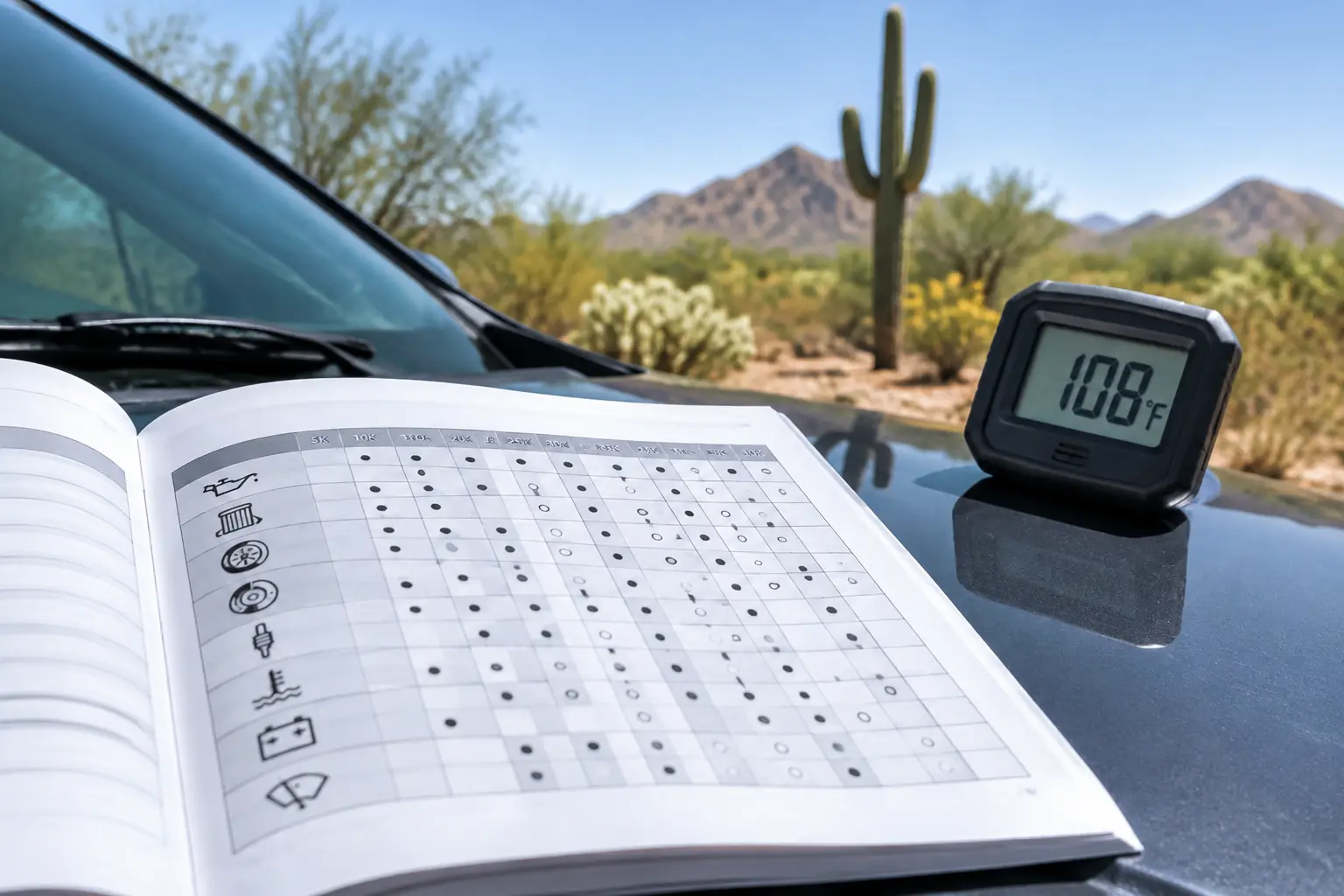
Tucson summer highs regularly exceed 100 degrees F, making hot-weather operating conditions a practical maintenance question rather than a hypothetical one.[3] Still, a Tucson address alone does not establish the correct interval. Some manuals identify high temperatures directly, while others describe a combination such as heavy traffic in hot weather. Match your routine to the complete description instead of stopping at the word heat.
Consider two driving patterns without assigning either a universal schedule. One driver travels steadily after the engine warms up. Another makes several brief trips along Oracle Rd, waits with the engine running, and repeats the pattern later. Those drivers may accumulate similar mileage while meeting different manufacturer definitions. The useful question is what happens during those miles, not simply how hot the parking lot feels.
Look for temperature thresholds, speed conditions, duration requirements, and words such as frequently or primarily. Do not substitute a general desert rule for those details. If your manual does not identify heat alone as severe use, do not invent that requirement. Instead, check whether your actual traffic, idling, dust exposure, or trip lengths satisfy another listed condition.
Dust and short trips can matter beyond summer
Dusty-road use and repeated short-distance driving are common reasons to check special maintenance requirements.[1] That means the schedule question does not disappear when Tucson temperatures become comfortable. A car making brief daily errands in cooler weather or regularly traveling an unpaved access road may still fit a severe-use description. Evaluate the routine across the year rather than treating severe service as a summer-only setting.
For short trips, compare your usual distance and operating conditions with the manual's definition. Some descriptions distinguish cold-weather short trips from other driving, so do not assume every quick drive qualifies under every manufacturer's rules. Write down a representative week, including stops and time spent idling. That gives you something concrete to compare with the manual instead of relying on a vague impression that you drive very little.
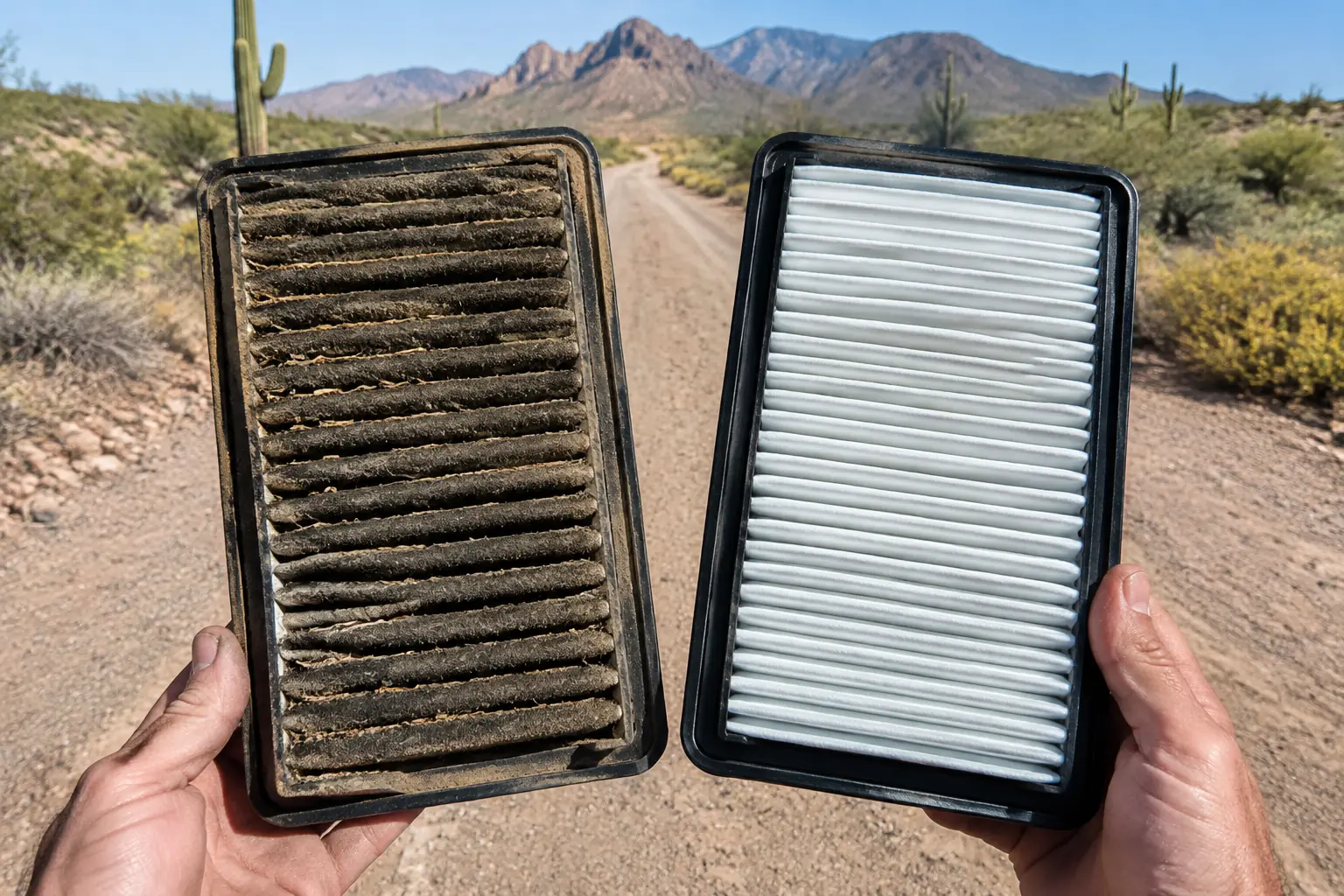
For dust, consider where you actually drive and park, including unpaved approaches and recurring construction exposure. A dust-related instruction may call for inspection rather than automatic replacement. Keep those actions separate when planning service. For the filter-specific side of the issue, see engine and cabin air filter maintenance in dusty Tucson rather than applying one replacement interval to every vehicle.
Find the maintenance information for your exact vehicle
Start with the owner's manual and any separate maintenance or warranty booklet supplied for your vehicle. If you need a digital copy, use the manufacturer's owner resources and confirm the model year. Check that the information applies to your engine, transmission, and market. A schedule for a similarly named model is not a dependable substitute, especially when the available powertrains have different maintenance requirements.
Search the document for maintenance schedule, severe service, special operating conditions, and additional maintenance. Manufacturers do not all organize the information the same way. The main chart may contain the normal intervals while a separate page explains exceptions. Consumer maintenance guidance likewise emphasizes following the vehicle's own maintenance requirements rather than relying on a universal schedule.[4] Read the surrounding notes before copying an interval into your calendar.
Keep the relevant pages together, including the chart, its legend, and the special-condition notes. Record the current odometer reading and the date and mileage of the last documented service. If someone else previously maintained the vehicle, gather those invoices too. You are building a small reference packet that connects the manufacturer's instructions with what has actually been done.
Read footnotes before choosing an interval
A maintenance table is only part of the instruction. Symbols can distinguish inspecting, replacing, adjusting, and checking fluid levels. Footnotes may limit a severe-use requirement to certain engines or operating conditions. Read across the entire row and then follow every referenced note. An inspection entry should not become a replacement recommendation simply because the vehicle spends its summers in Tucson.
Pay equal attention to mileage and elapsed time. When the manufacturer says whichever comes first, the earlier limit controls, even if you have not driven far. Maintenance schedules commonly use both time and mileage, which is why a low odometer reading does not by itself settle what is due.[4] Copy both limits into your records rather than keeping only the mileage number from a reminder sticker.
It helps to translate the chart into one sentence for each task: what the task is, which condition changes it, and when it comes due. Then check that sentence against the original page. If the table appears to conflict with a footnote or another booklet, ask for clarification using those exact passages. Guessing at the shorter number is not the same as understanding the requirement.
Apply special conditions to the items they actually cover
Treat severe service as a set of specific instructions, not a blanket discount on every normal interval. A dust-related note may affect inspection frequency for one item, while a towing-related note may affect a different system. Follow the connection the manufacturer makes. This approach avoids both missed maintenance and a service list expanded solely because desert driving sounds hard on a vehicle.
Build your plan around individual entries for engine oil, filters, fluids, and scheduled inspections. Beside each entry, note whether the normal instruction remains in place or a special-condition instruction applies. You do not need an elaborate spreadsheet. A clear note in your maintenance folder can be enough, provided it preserves the time limit, mileage limit, and reason for the adjustment.
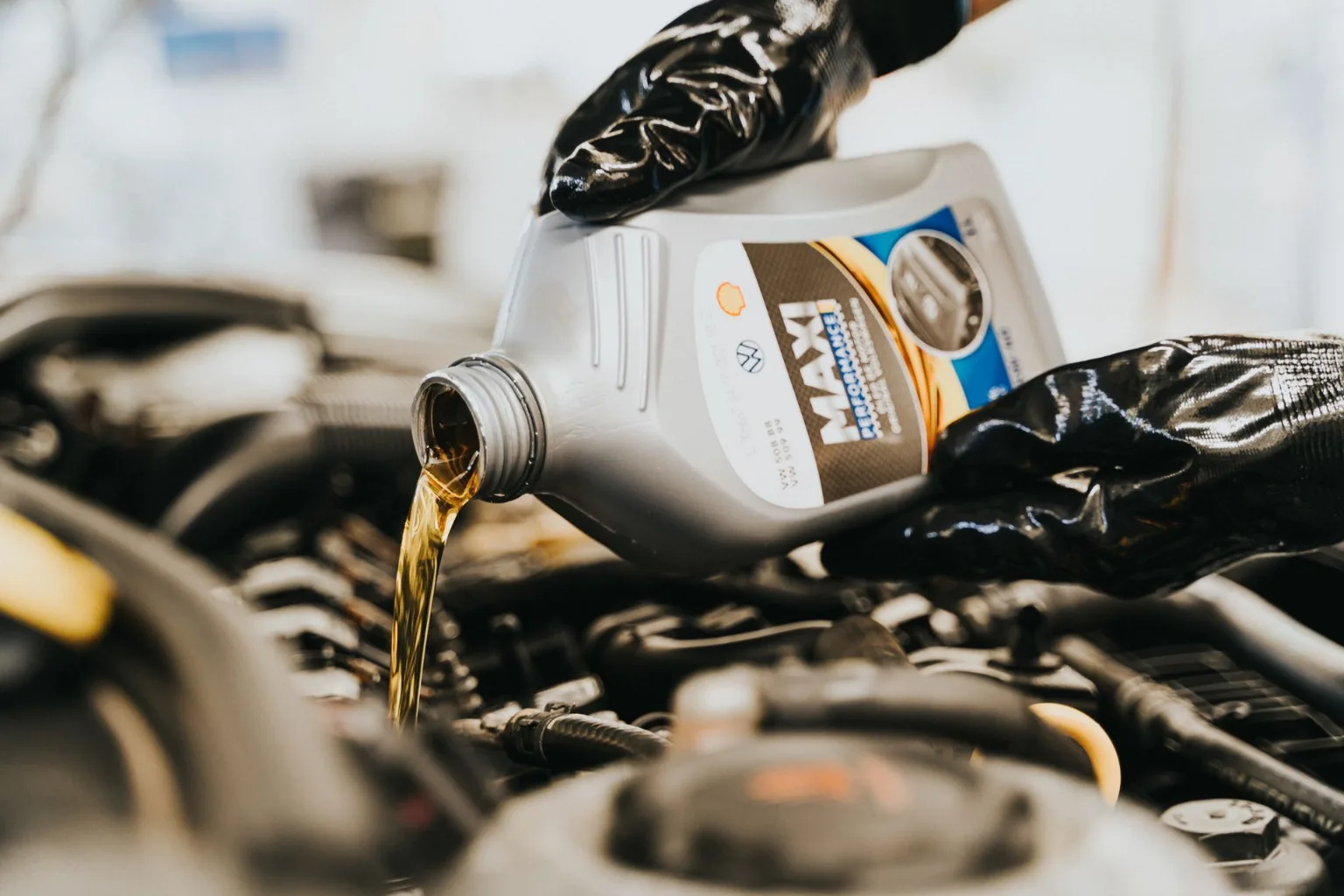
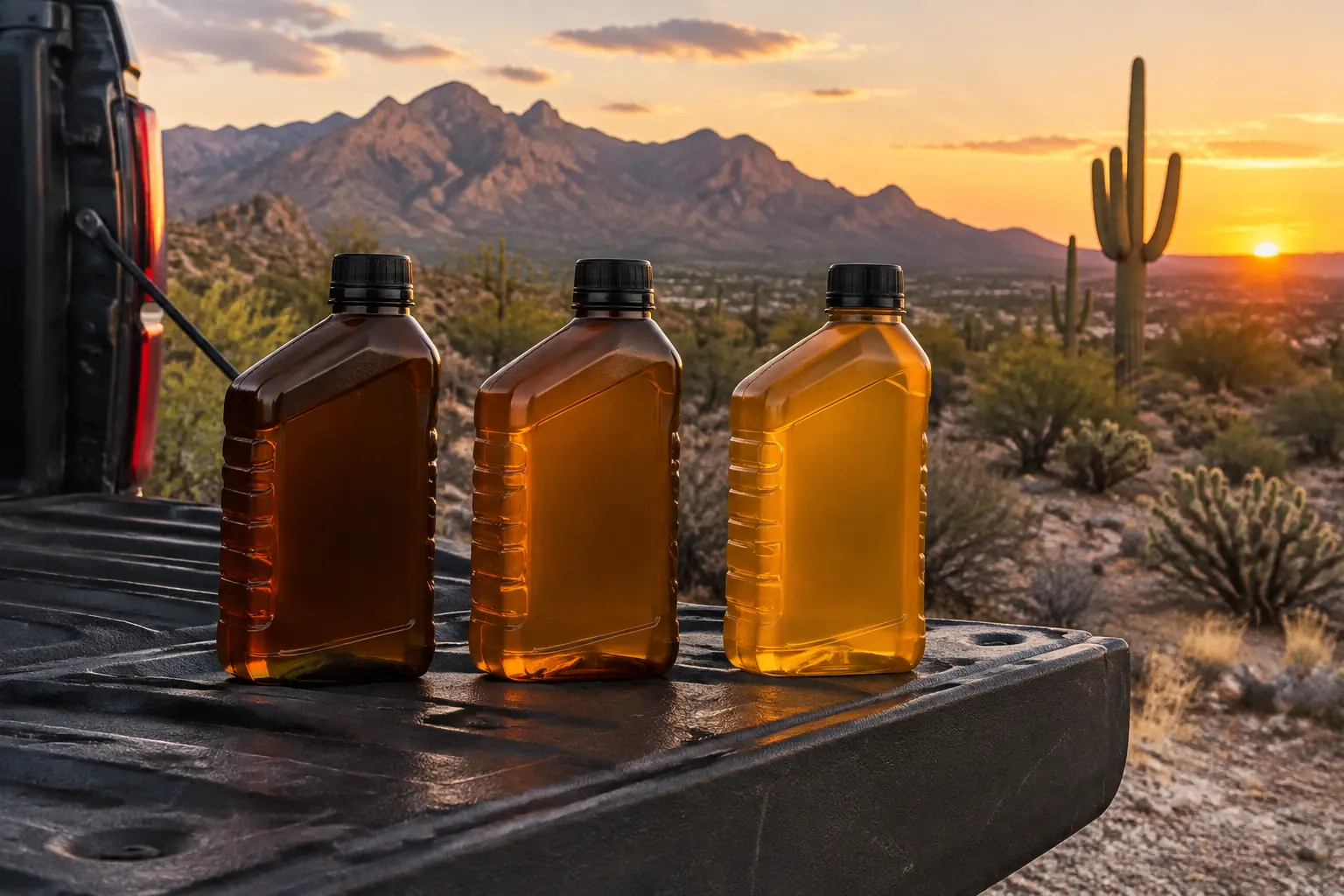
Also keep fluid specifications separate from service timing. The Department of Energy recommends using the motor oil grade specified by the manufacturer.[5] Choosing the correct oil does not answer every question about when it is due, and choosing a shorter interval does not justify using the wrong specification. Our guide to synthetic and conventional oil in Arizona covers that separate decision without replacing your maintenance schedule.
Know what your oil-life display does and does not tell you
If your vehicle has an oil-life display or maintenance reminder, read the manual's explanation of that system alongside the schedule. Identify which instructions depend on the display, which have a separate calendar limit, and whether special operating conditions require additional action. Do not assume that every dashboard reminder uses the same method or covers the same maintenance tasks.
A useful question is, "Does this reminder cover this particular service?" An oil reminder is not a substitute for reviewing every other row in the maintenance chart. Likewise, a recently reset display is not documentation that the correct work occurred. Compare the reminder with your invoice and service history, especially after buying a used vehicle or changing who maintains it.
Ask that reminder resets be tied to completed work and recorded with the date and mileage. If the displayed information seems inconsistent with your records, resolve the discrepancy rather than automatically restarting the count. Your goal is a traceable starting point. That makes the next service decision easier and keeps a dashboard number from becoming the only evidence you have about maintenance.
Use Tucson's summer transition as a schedule review
The stretch from the first sustained heat into monsoon weather is a useful annual checkpoint for your maintenance plan. Tucson's monsoon season officially runs June 15 through September 30.[3] That calendar window does not create a new manufacturer interval. It simply gives you a consistent time to ask whether your driving pattern has changed since you last reviewed the schedule.
Perhaps your commute now includes more waiting along Grant Rd, or a temporary route in Marana includes an unpaved approach. Record those changes and compare them with the manual's listed conditions. Dust storms are also a regional driving hazard, but immediate storm safety and long-term maintenance are different decisions.[6] Do not treat a maintenance appointment as a substitute for responding safely to current road conditions.
Review what happened rather than automatically ordering a seasonal package. Did your mileage increase? Are you idling more often? Have short errands replaced a longer commute? Those observations help determine which requirements apply going forward. Keep previously completed maintenance in the record, and do not restart an interval merely because summer ended or the first storm arrived.
What The Mando Guild checks on-site in Tucson
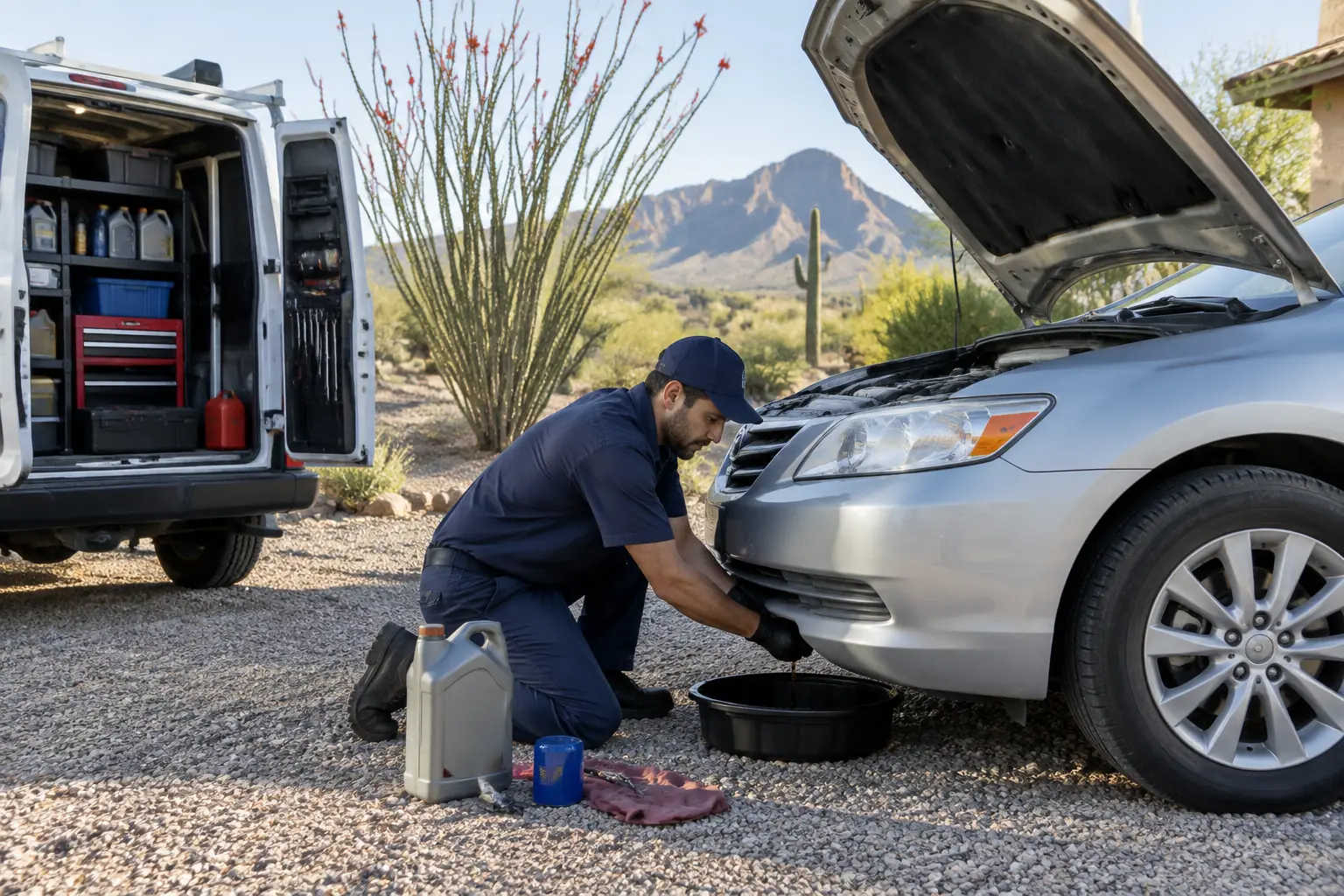
The Mando Guild is a mobile mechanic service, not a walk-in shop. We drive a stocked service van to your home, workplace, or roadside location in greater Tucson. For a maintenance visit, the starting point is your vehicle information, current mileage, available service records, and description of how you drive. Have the relevant manual pages available if you have already identified a special-condition note.
Every job starts with a diagnosis and a written estimate, and nothing is replaced until you approve it. For this topic, that means separating scheduled work from items that need inspection or further diagnosis. We compare the applicable maintenance instructions with your records and check the items relevant to the requested service. An undocumented service is a question to resolve, not proof that a component has failed.
The written estimate gives you a chance to understand the proposed work before authorizing it. Ask which recommendation comes from the schedule and which comes from a finding on the vehicle. You can request mobile oil changes and maintenance without treating every inspection as permission to replace parts. Keeping that distinction clear makes a severe-service plan easier to follow and easier to review later.
Turn the correct schedule into your next service date
Once you have identified the applicable requirements, set the next due date and mileage for each affected task. Use the last documented completion as your starting point, following the manufacturer's instructions. If records are missing, flag the uncertainty and discuss how to establish a reliable baseline. Do not label every item overdue simply because the maintenance folder is incomplete.
Save the invoice with the date, odometer reading, work completed, and relevant fluid or part information. Add a brief note explaining why a special interval applies, such as the specific short-trip or dusty-road condition in your manual. Revisit that note when your commute or vehicle use changes. A good maintenance plan should remain understandable months later, not depend on remembering a conversation.
The right severe service schedule for Tucson is the one supported by your vehicle's instructions and your actual driving. You do not need a generic desert interval or an automatic list of replacements. For help checking the requirements and planning approved work, call (520) 704-0441 or request service from The Mando Guild, Monday through Friday, 8 a.m. to 5 p.m.
Sources
- Edmunds, "Car Maintenance." www.edmunds.com/car-maintenance/ (opens in a new tab)
- Car Care Council, "Car Care Guide." www.carcare.org/car-care-guide/ (opens in a new tab)
- National Weather Service, Tucson, "NWS Tucson Forecast Office." www.weather.gov/twc/ (opens in a new tab)
- Consumer Reports, "Your Car Maintenance Checklist." www.consumerreports.org/cars/car-repair-maintenance/your-car-maintenance-checklist-a6808357212/ (opens in a new tab)
- U.S. Department of Energy, FuelEconomy.gov, "Keeping Your Vehicle in Shape." www.fueleconomy.gov/feg/maintain.jsp (opens in a new tab)
- National Weather Service, "Dust Storm Safety." www.weather.gov/safety/wind-dust-storm (opens in a new tab)
FAQ
Quick answers
Keep reading
 Pillar guideThe Tucson Driver's Guide to Mobile Oil Changes and MaintenancePlan mobile oil changes and seasonal maintenance around Tucson's heat, dust, and monsoon weather without a trip to a shop.Read more: The Tucson Driver's Guide to Mobile Oil Changes and Maintenance →
 9 min readChoosing the Right Engine Oil for Tucson Summer HeatLearn how oil chemistry, viscosity, and your engine's specifications guide the right oil choice for Tucson summer driving.Read more: Choosing the Right Engine Oil for Tucson Summer Heat →
 9 min readWhen Tucson Dust Means Your Air Filters Need ChangingLearn when Tucson dust calls for engine and cabin filter checks, what symptoms mean, and how mobile replacement works.Read more: When Tucson Dust Means Your Air Filters Need Changing →