
Check engine & diagnostics · Pillar guide
Check Engine Light in Tucson: What It Means and What to Do
9 min readBy The Mando Guild mechanics
A check engine light in Tucson means your car's onboard computer has detected an engine, emissions, or related powertrain problem. The Mando Guild helps you find the cause with mobile diagnosis at your home, workplace, or a safe roadside location, followed by a written estimate before you approve any replacement.
What the check engine light actually tells you
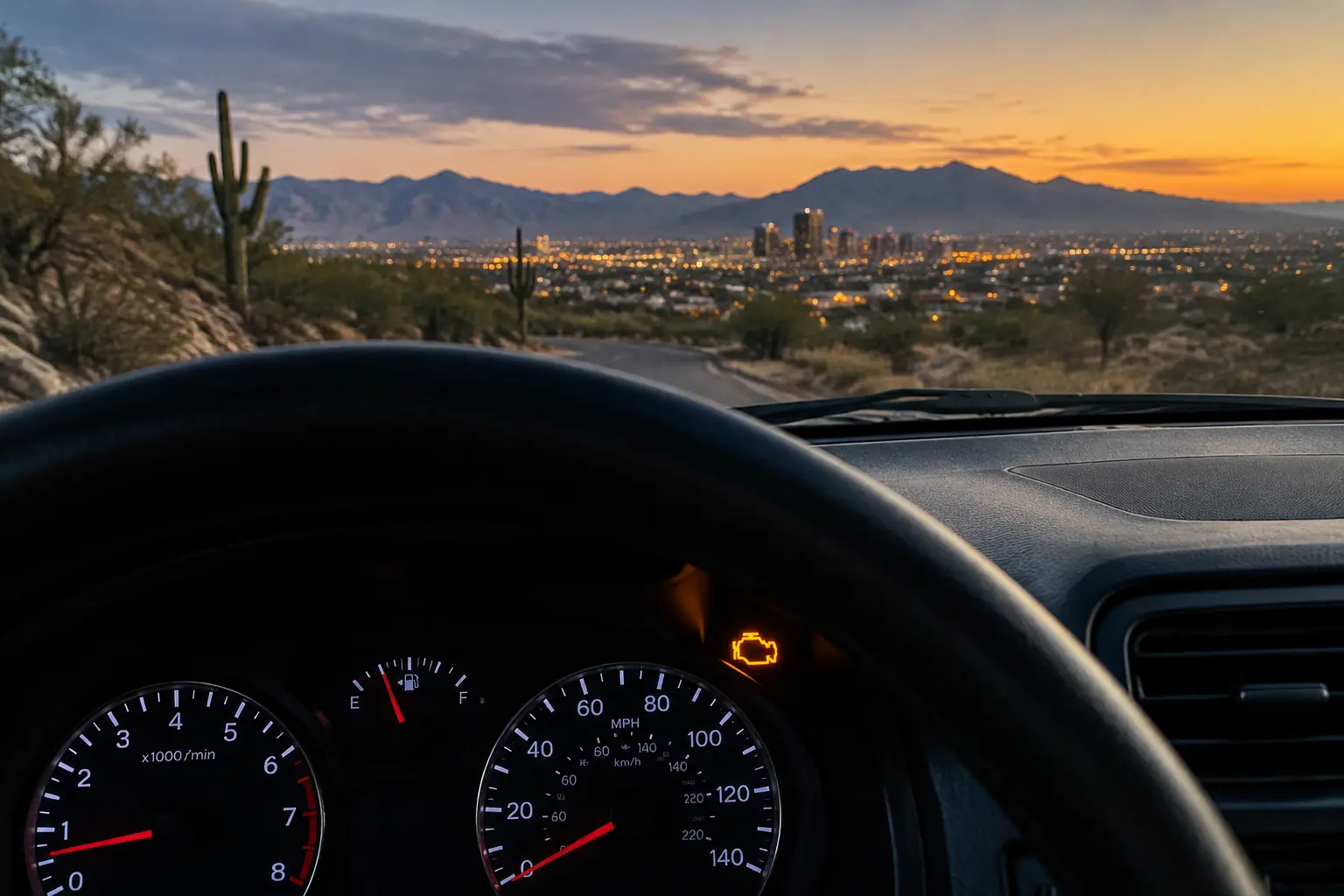
The check engine light is a message from your vehicle's monitoring system, not a verdict that the engine needs replacement. Depending on your dashboard, it may appear as an engine-shaped symbol or words such as "service engine soon." It signals a detected fault that needs investigation, but the symbol alone does not identify the failed component.[1]
Your vehicle monitors how the engine runs and how emissions-related systems behave. A problem with combustion, fuel control, or vapor containment can turn on the same light. Some transmission-related faults can also trigger it. That broad coverage explains why two cars with identical warning lights can need very different repairs. The starting point is the vehicle's evidence, not a familiar repair someone else needed.
Do not confuse this warning with an oil change reminder or a red oil-pressure warning. Those messages ask for different responses. Check your owner's manual if the symbol is unfamiliar, and note any other lights showing beside it. Our guide to dashboard warning light colors helps you distinguish a service reminder from a warning that calls for stopping.
A steady light and a flashing light need different responses
A steady check engine light generally means you should arrange diagnosis promptly. It does not automatically mean you must stop in the nearest traffic lane, and it does not guarantee the car is safe for unrestricted driving. A flashing light commonly signals a severe misfire that can damage the catalytic converter. Treat that as an urgent warning.[1]
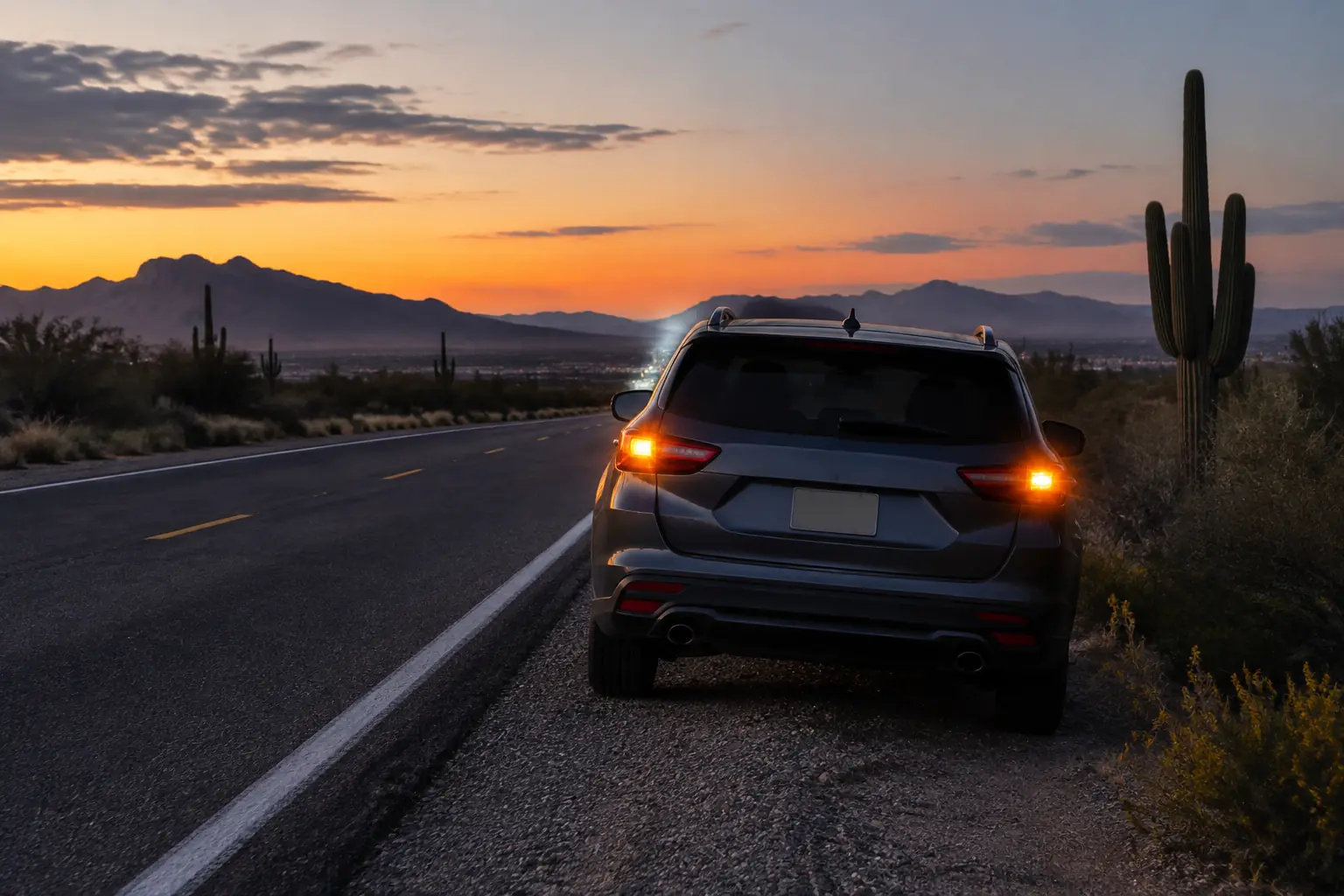
If the light flashes, reduce engine load and move out of traffic to a safe stopping place. Shut the engine off once safely parked rather than continuing your trip to see if the warning clears. Arrange assistance, with towing if needed. Our flashing check engine light response guide covers the immediate decisions without asking you to troubleshoot beside moving traffic.
Symptoms can make a steady light urgent, too. Severe shaking, substantial power loss, smoke, overheating, or an oil-pressure warning are reasons to stop safely rather than keep driving. On I-10 or Oracle Road, focus first on reaching a safe position, not reading a scanner. If the car runs normally with a steady light, avoid hard acceleration and unnecessary trips while arranging an assessment.
What OBD-II codes can and cannot tell you
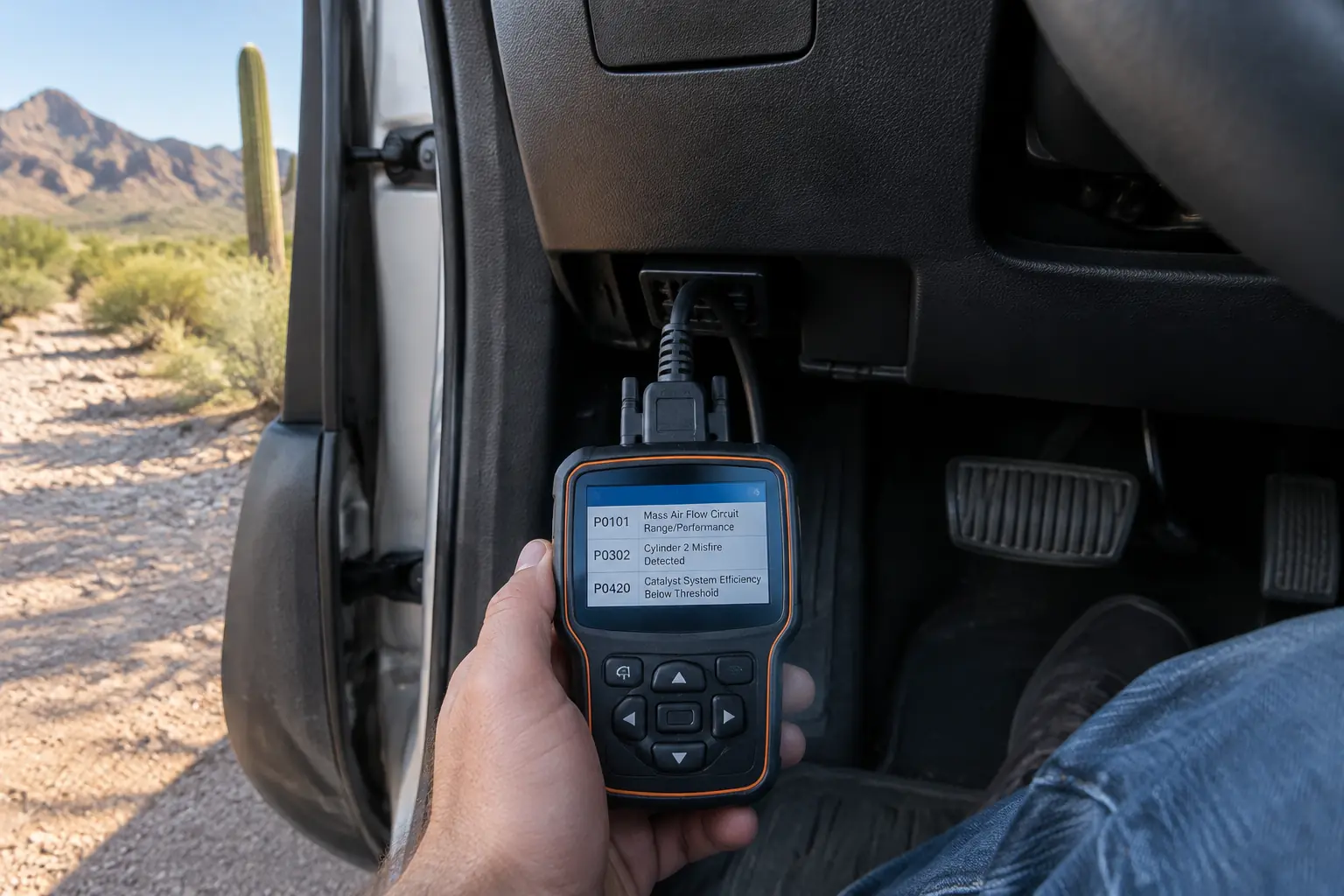
OBD-II is the standardized onboard diagnostic system used on most U.S. passenger vehicles from model year 1996 onward. It stores diagnostic trouble codes when monitored conditions meet fault criteria. A scan tool retrieves that information through the vehicle's diagnostic connector. The system helps identify emissions-related problems and is also used in inspections of applicable vehicles.[2]
A code describes a detected condition or circuit problem. It usually does not establish which part caused it. An oxygen-sensor-related code, for example, can require checking wiring, exhaust leaks, or fuel control before condemning the sensor. A misfire code identifies a combustion problem but does not, by itself, prove that a spark plug or ignition coil needs replacement.
A useful assessment goes beyond reading the code number. Depending on the vehicle, it may include stored and pending codes, freeze-frame information captured around the fault, and live operating data. These details help connect the warning to actual conditions. Our guide to OBD-II trouble codes explains the terminology, while the practical rule stays simple: A code points toward testing, not straight toward a parts order.
Common fault categories worth checking in Tucson
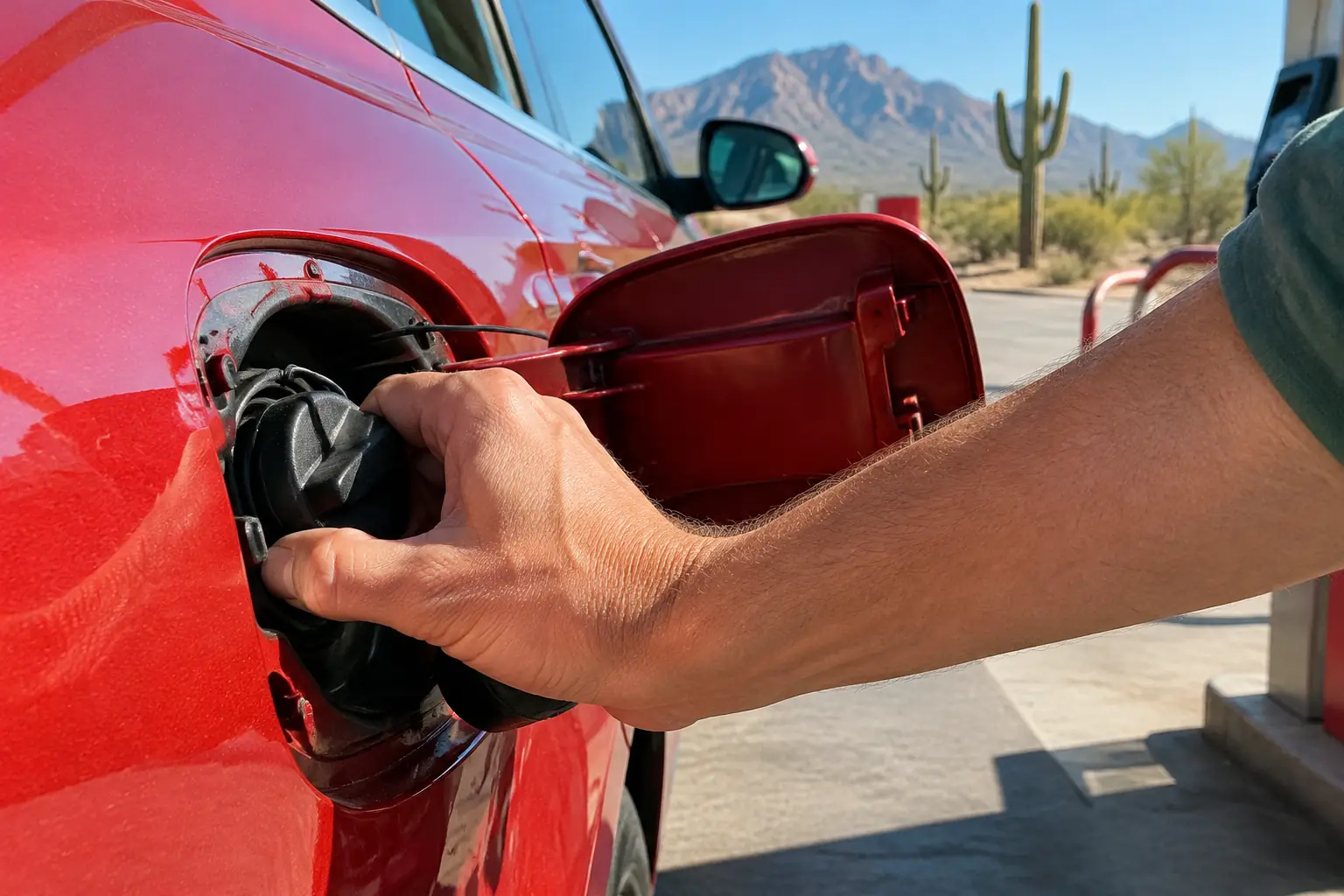
Fuel-vapor system faults are one possible explanation, especially when the warning appears after refueling. On vehicles with a removable cap, a loose cap or damaged seal can prevent the system from sealing correctly. Other leaks or control faults can produce similar warnings, so tightening the cap is not a complete diagnosis.[1] Our gas cap and EVAP code guide covers that narrower situation.
Misfires, air leaks, fuel-delivery problems, sensor faults, and catalyst-efficiency issues are other diagnostic categories. A rough idle helps narrow the investigation, but several faults can feel alike from the driver's seat. Likewise, a catalyst-related code does not justify installing a converter without considering the conditions that could have damaged it or affected the reading. Testing should establish the cause before an expensive replacement.
Tucson heat also makes electrical condition worth considering when the symptoms and codes support it. High temperatures can accelerate battery deterioration.[3] That does not make every engine warning a battery problem. It means a technician may need to verify power supply and connections rather than assume every stored fault represents a separate failed component. Your vehicle's symptoms determine the appropriate checks.
Tucson heat and monsoon conditions add useful clues
When summer temperatures climb above 100 degrees F, record whether the warning appears during a cold start, after a hot restart, or while sitting in traffic on Grant Road. Tucson's official monsoon season runs June 15 through September 30, adding another seasonal detail to your symptom history.[4] Weather is context for diagnosis, not proof that the weather itself caused the fault.
Tell the technician about recent dusty driving, heavy rain exposure, refueling, or a climb on Catalina Highway. Also note whether the air conditioning was running and whether the vehicle was carrying a heavier load than usual. A problem that appears only under load may require a different test approach from one that occurs while idling in your driveway. Do not deliberately recreate a dangerous symptom to collect information.
Keep overheating separate from a routine check engine appointment. A rising temperature gauge, steam, or an overheating message calls for stopping safely and letting the engine cool; never open a hot cooling-system cap.[5] During monsoon storms, do not drive through flooded roadways to reach a service location. Water depth and road condition can be deceptive, so turn around instead.[6]
How the warning connects to Pima County emissions testing
Many vehicles registered in the Tucson emissions-control area require testing through Arizona's myAZcar program. Requirements depend on the vehicle and registration circumstances, so check your renewal notice and the program's current guidance rather than assuming every Pima County vehicle follows the same rules. An illuminated check engine light can prevent an applicable vehicle from passing its OBD inspection.[2]
The inspection also considers readiness monitors, which indicate whether the vehicle has completed certain self-checks. Clearing codes or disconnecting the battery can reset those monitors. That can leave the vehicle unready for testing even if the dashboard light is temporarily off. Resetting the warning is therefore not a substitute for repairing the underlying problem and allowing the required checks to run.[2]
If registration renewal is approaching, mention the deadline when requesting diagnosis. Leave room for testing, an approved repair, and verification instead of treating the inspection station as the first diagnostic stop. There is no universal mileage that makes every vehicle ready. Our Arizona emissions and check engine light guide explains that connection in more detail. Mobile diagnosis does not replace the official state emissions inspection.
What to record before your diagnostic appointment
Start with the vehicle's year, make, model, and approximate mileage. Then describe what happened in ordinary language: The light appeared after filling up, the engine shook at a stop, or acceleration became sluggish. Note whether the warning stayed steady or flashed. A short description of the sequence is more useful than guessing a failed part from an online search result.
If it is safe, take a dashboard photo while parked and write down other messages. Mention recent repairs, a battery disconnect, a jump start, or any codes someone has already read. Save the actual code numbers instead of only a scanner's suggested repair description. Do not erase stored information before the appointment unless a qualified technician specifically directs you to do so.
You can also inspect the fuel cap, if your vehicle has one, with the engine off and the vehicle parked safely. Follow the owner's manual for securing it. Avoid unplugging sensors, reaching near moving belts, or opening hot systems. If there is a strong fuel odor or visible fuel leakage, stop using the vehicle and request guidance rather than experimenting with restarts.
How The Mando Guild diagnoses your vehicle on-site
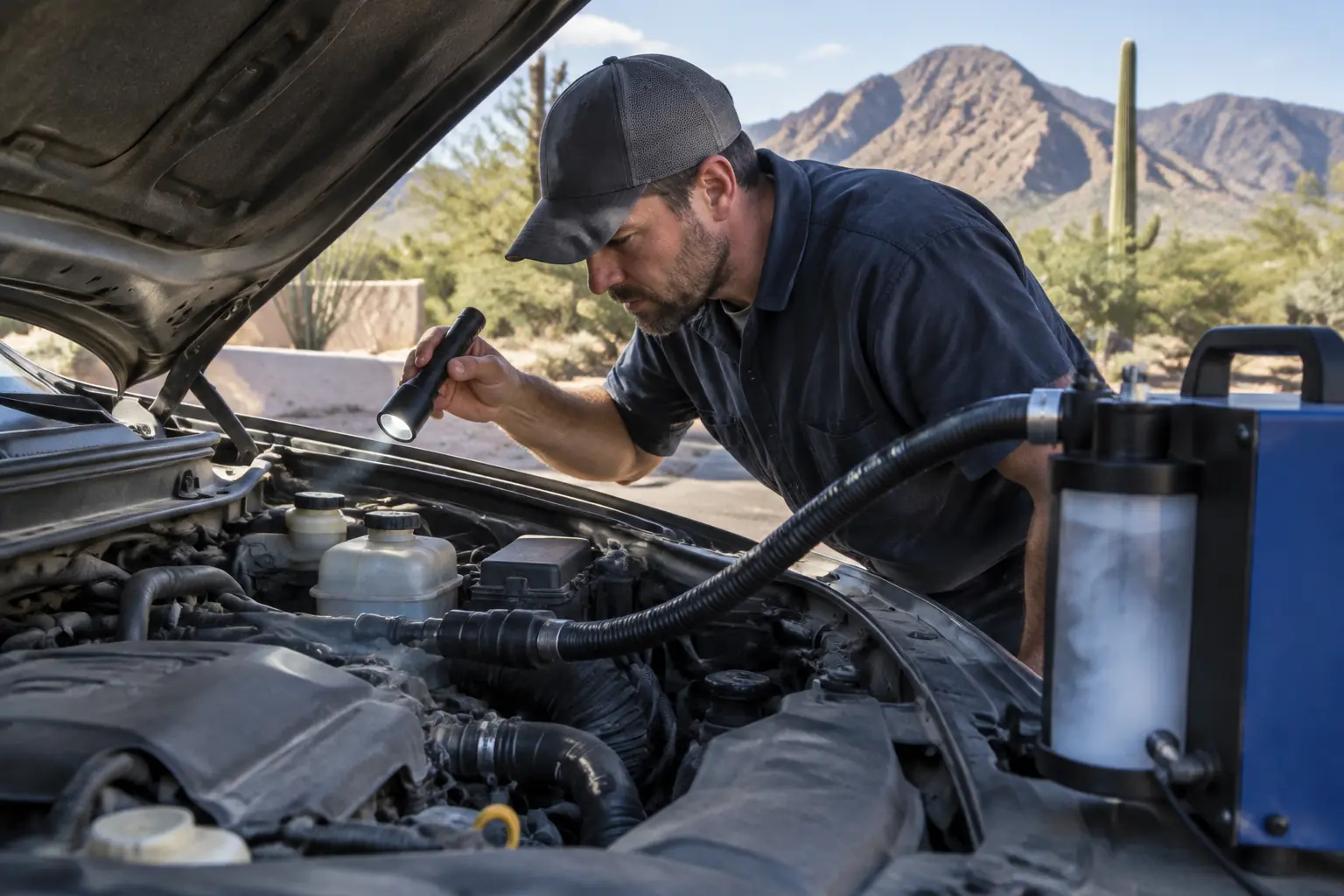
The Mando Guild brings a stocked service van to your home, workplace, or safe roadside location. We serve most makes and models across greater Tucson, including Flowing Wells, Amphi, Casas Adobes, Catalina Foothills, Oro Valley, and Marana. Our registered hub on West Roger Road is not a walk-in shop. Service happens at the agreed location, where access and working conditions must be suitable.
Every job starts with diagnosis. For a check engine concern, that means discussing the symptoms, checking the warning status, retrieving relevant diagnostic information, and choosing tests based on what we find. Depending on the fault, checks may involve wiring and connections, intake components, operating data, or supporting electrical tests. Reading a code is one step in that process, not the whole service.
We explain the findings and provide a written estimate before you decide how to proceed. Nothing is replaced until you approve it, and we use OEM-grade parts. Some conditions need further testing or equipment beyond what is practical at your location; an on-site visit should not be mistaken for a promise that every fault can be repaired there. Our mobile diagnostics service starts with finding the cause.
How to judge the repair plan and verification
A useful repair recommendation connects three things: Your complaint, the test findings, and the proposed work. Ask what evidence supports the suspected cause and whether any related issue needs attention. If several codes are present, ask which fault is being addressed first and why. One underlying problem can affect multiple readings, so a long code list should not automatically become a long replacement list.
After an approved repair, verification should fit the original concern. That may mean checking operating data, confirming that a misfire is no longer present, or watching for returning faults under appropriate conditions. Some self-checks require additional operation before their status is known. The warning being off immediately after codes are cleared is not, by itself, proof that the original problem has been resolved.
Keep the diagnostic findings and repair record with your maintenance information. Fixing a genuine engine-performance problem can also help restore fuel economy, although the result depends on the fault and the vehicle.[7] Avoid promises of a specific mileage improvement or a guaranteed emissions pass based only on replacing a commonly blamed part. The goal is a verified repair, not simply a dark dashboard.
Make a safe plan for check engine diagnosis in Tucson
Your next step depends on the warning behavior and the way the vehicle runs. A flashing light or serious symptoms calls for a safety-first response. A steady light with normal operation calls for prompt investigation rather than weeks of waiting. Neither situation benefits from buying parts solely because the same model had a similar complaint on a discussion board.
When requesting mobile service, share the vehicle details, symptoms, location, and any access restrictions. A driveway in Midtown and a workplace parking lot near the University of Arizona may offer different working conditions. Permission to work on the property matters, as does room around the vehicle. If you are stopped beside traffic, describe that clearly so roadside safety is considered before any diagnostic work.
The Mando Guild serves greater Tucson without requiring a trip to a walk-in shop. Roadside help is available only during business hours, and we are closed Saturday and Sunday. Call (520) 704-0441 or request service Monday through Friday, 8 a.m. to 5 p.m., to arrange diagnosis and a written estimate.
Sources
- Car Care Council, "Don't Let the Check Engine Light Turn You Off From Making Needed Repairs." media.carcare.org/2018-05-01-Dont-Let-the-Check-Engine-Light-Turn-You-Off-From-Making-Needed-Repairs (opens in a new tab)
- Arizona Department of Environmental Quality, "myAZcar Vehicle Emissions Program." myazcar.com/ (opens in a new tab)
- AAA Mountain West Group, "How to Prevent Heat Damage to Your Car Battery." mwg.aaa.com/via/car/prevent-heat-damage-car-battery (opens in a new tab)
- National Weather Service, Tucson, "NWS Tucson Forecast Office." www.weather.gov/twc/ (opens in a new tab)
- Car Care Council, "Car Care Guide." www.carcare.org/car-care-guide/ (opens in a new tab)
- National Weather Service, "Turn Around Don't Drown." www.weather.gov/safety/flood-turn-around-dont-drown (opens in a new tab)
- U.S. Department of Energy, FuelEconomy.gov, "Keeping Your Vehicle in Shape." www.fueleconomy.gov/feg/maintain.jsp (opens in a new tab)
- National Highway Traffic Safety Administration, "Safety Issues & Recalls." www.nhtsa.gov/recalls (opens in a new tab)
FAQ
Quick answers
Keep reading
 9 min readFlashing Check Engine Light in Tucson: Your Next Five MinutesLearn when to stop, how to protect your catalytic converter, and who to call when your check engine light flashes in Tucson.Read more: Flashing Check Engine Light in Tucson: Your Next Five Minutes →
 9 min readOBD-II Trouble Codes Explained for Tucson DriversLearn what OBD-II codes tell Tucson drivers, what freeze-frame data adds, and why a scan alone cannot identify the repair.Read more: OBD-II Trouble Codes Explained for Tucson Drivers →
 9 min readLoose Gas Caps and EVAP Warning Lights in Tucson HeatLearn why Tucson heat exposes EVAP problems, what P0455 and P0456 mean, and how testing separates a loose cap from another leak.Read more: Loose Gas Caps and EVAP Warning Lights in Tucson Heat →