
Check engine & diagnostics · Guide
Will a Check Engine Light Fail Your Tucson Emissions Test?
9 min readBy The Mando Guild mechanics
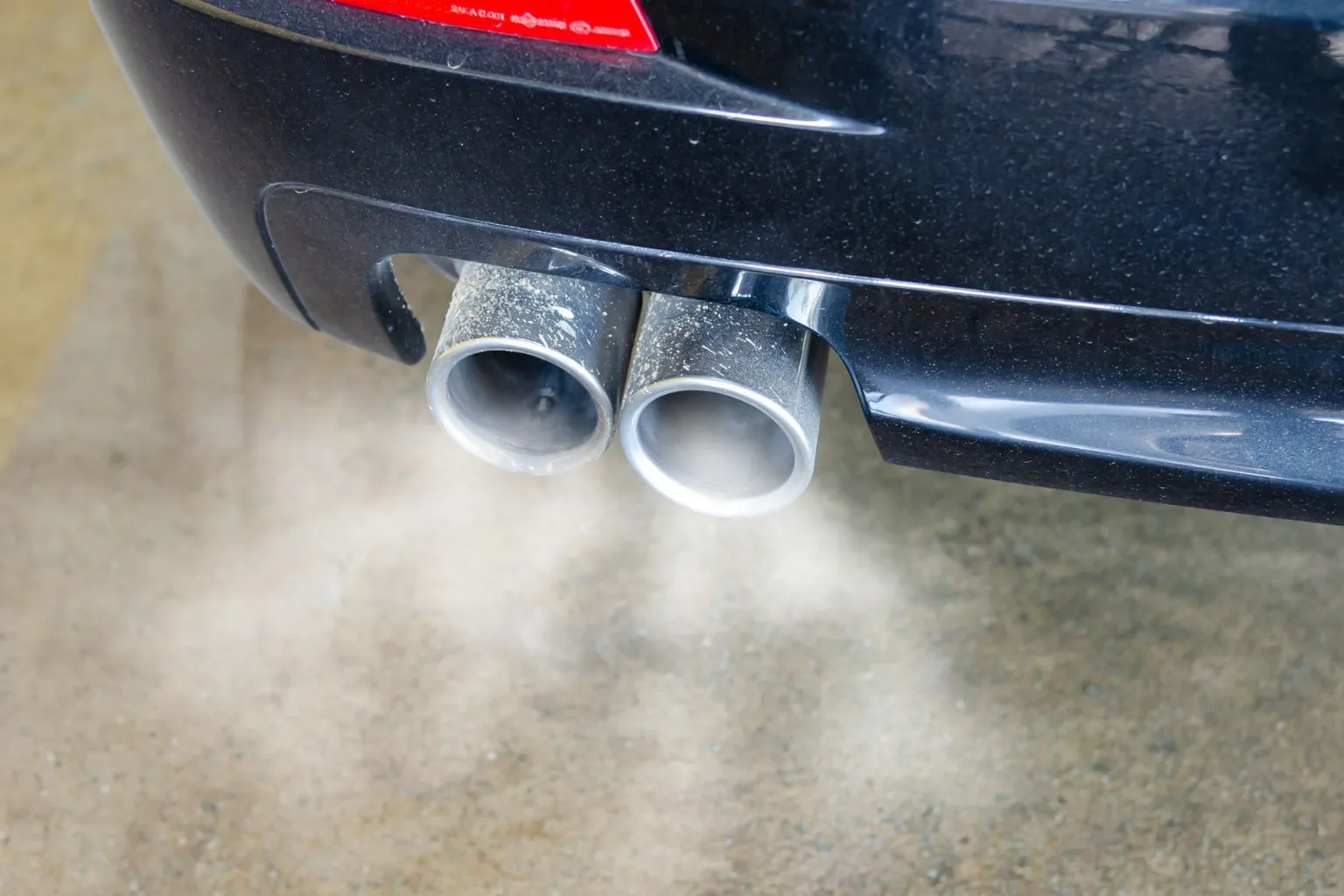
An illuminated check engine light generally means your Tucson vehicle will fail an emissions test that uses its onboard diagnostic system. The Mando Guild helps Tucson car owners diagnose the fault, approve needed repairs, and check readiness before visiting an Arizona emissions testing station.
When a check engine light means a failed test
For a vehicle receiving an onboard diagnostics, or OBD, emissions inspection, a check engine light that stays on while the engine runs is a reason to address the vehicle before testing. The inspection checks information from the vehicle's computer, including its malfunction indicator status. Turning the dashboard light off without resolving the problem does not establish that the vehicle can pass.[1]
That answer needs one qualification: Arizona does not give every vehicle the same inspection. Model year, fuel type, and other vehicle details affect testing requirements. Older vehicles may receive a different test, so avoid applying an OBD rule to every car or truck. Use the state's myAZcar program to confirm the requirements for your particular vehicle rather than relying on a neighbor's experience.[1]
The check engine light is also different from a maintenance reminder. An oil service message does not mean the same thing as an engine-shaped warning lamp. If you are unsure which warning you have, our Tucson check engine light guide explains that distinction. For test planning, identify the warning first, then check the vehicle's diagnostic status.
How Pima County emissions requirements apply to you
Many vehicles in the Tucson metropolitan emissions control area must undergo testing through Arizona's program. That does not mean every vehicle everywhere in Pima County has identical requirements. Registration location, vehicle characteristics, and exemptions can affect eligibility. Your registration renewal information and the myAZcar program are the appropriate starting points for confirming whether testing is required.[1]
Before making a trip from Flowing Wells, Midtown, or the Catalina Foothills, check the current station information and instructions through myAZcar. Confirm the applicable inspection instead of assuming Tucson and Phoenix procedures are interchangeable. If your registration information leaves you uncertain, resolve that question with the program before paying for work intended specifically to prepare the vehicle for testing.[1]
Keep the official inspection separate from repair preparation. A mechanic can diagnose faults and inspect readiness information, but that work is not the state's emissions certificate. The Mando Guild provides mobile diagnostic and repair services, not an official emissions inspection. Our role is to help you understand what needs attention before you take the vehicle to the testing station.
Why a dark dashboard light does not prove readiness
Readiness monitors are the vehicle computer's records of whether particular emissions self-checks have run. A monitor marked incomplete or not ready has not finished its check since the relevant reset. That status is different from a confirmed failed component. It also means a vehicle can have no illuminated check engine light and still lack the readiness needed for its inspection.[1]
Think of the light and readiness as answering separate questions. The light reports a detected problem that meets the computer's warning criteria. Readiness reports whether the computer has completed specified checks. An inspection needs usable information, not just a dashboard without warnings. Arizona's allowances for incomplete monitors depend on the applicable vehicle and test requirements, so do not assume every monitor must always show complete.[1]
A useful pretest scan checks the malfunction indicator command, diagnostic trouble codes, and supported readiness monitors together. Ask which monitors remain incomplete, rather than accepting only a general statement that the codes were cleared. A monitor listed as unsupported is not the same as a supported monitor that has not run. Those distinctions help determine what should happen next.
Why disconnecting the battery can delay your test
Disconnecting the battery or clearing diagnostic codes can reset emissions readiness information. The light may disappear temporarily while the computer has not yet repeated its checks. Arriving at a station immediately afterward can leave the vehicle unready for inspection even if it starts, idles, and drives normally. A reset is not a substitute for correcting the underlying fault.[1]
Battery replacement is sometimes necessary, and you should not keep an unreliable battery simply to preserve readiness. Arizona heat makes battery condition worth watching because excessive heat can shorten battery life.[2] The scheduling lesson is straightforward: tell your mechanic that an emissions deadline is approaching before battery work, diagnostic resets, or other work that could affect the computer's stored information.
If the battery was recently disconnected, share when it happened and how the vehicle has been used since then. Do not repeatedly disconnect it to chase away a returning warning. Repeated resets can erase useful diagnostic information and restart the readiness process. Preserve the current scan information first, then let the repair and verification plan determine whether clearing codes is appropriate.
Plan Tucson emissions repairs before renewal week
The practical time to address a warning light is before your renewal deadline becomes urgent. Diagnosis, an approved repair, and postrepair verification are separate steps. Even when a repair is completed promptly, the vehicle may still need appropriate operation before its monitors finish. Arizona's program warns against testing immediately after a battery disconnect or computer reset because readiness may be incomplete.[1]
Start by confirming your deadline and checking whether the light stays on with the engine running. Gather any previous failure report and note recent battery work or code clearing. Then schedule diagnosis with room for follow-up. Leave flexibility rather than treating the day before registration renewal as a guaranteed repair-and-test window. The fault and the vehicle's monitor requirements determine the actual sequence.
A sensible plan also avoids replacing parts based only on a code description. A trouble code identifies a condition the computer detected, not necessarily the part that caused it. Our guide to OBD-II trouble codes explains why testing comes before a parts decision. That distinction matters when you are trying to spend your preparation time on the repair the vehicle actually needs.
Why there is no universal drive to make monitors ready
There is no single mileage promise that makes every vehicle ready. Emissions self-checks require particular operating conditions, and those conditions vary by vehicle and monitor. Simply driving farther does not guarantee completion. Follow vehicle-specific guidance and check readiness afterward instead of assuming a certain number of miles will satisfy the inspection.[1]
A drive cycle may involve a combination of starting conditions, temperatures, speeds, and periods of operation. Some checks will not run if their prerequisites are missing or another fault interferes. That is why a long trip can leave a monitor incomplete while ordinary driving under the right conditions may allow it to finish. The next step should come from the scan results and applicable service information.
Do not turn I-10, Oracle Road, or neighborhood streets into a test course. Never attempt abrupt braking, unsafe speeds, or distracted scan-tool watching to follow an internet drive-cycle recipe. If a specific procedure is needed, discuss how it can be performed safely and legally. A passenger or technician can review data where appropriate, but the driver needs to concentrate on traffic.
What Tucson heat and monsoon timing change
Tucson's summer heat and seasonal storms make last-minute test preparation less convenient. The official monsoon season runs from June 15 through September 30.[3] If your renewal falls during that stretch, allow time for diagnosis and ordinary postrepair driving rather than depending on one long outing after work. Weather and traffic should not pressure you into driving a vehicle with unresolved symptoms.
Battery trouble can also complicate that schedule. Heat can contribute to battery deterioration, so a weak battery deserves attention rather than being ignored until after the emissions visit.[2] Tell the mechanic about slow starting or a recent jump start. Those details help separate a necessary starting-system repair from the emissions concern and allow both issues to be planned together.
If the check engine light flashes, the vehicle runs severely rough, or it loses power, stop treating the situation as a registration errand. A flashing light can indicate a serious misfire that risks catalytic converter damage.[4] Our flashing check engine light guide covers the immediate response. Readiness driving should wait until the vehicle's condition supports safe operation.
What The Mando Guild checks at your Tucson location
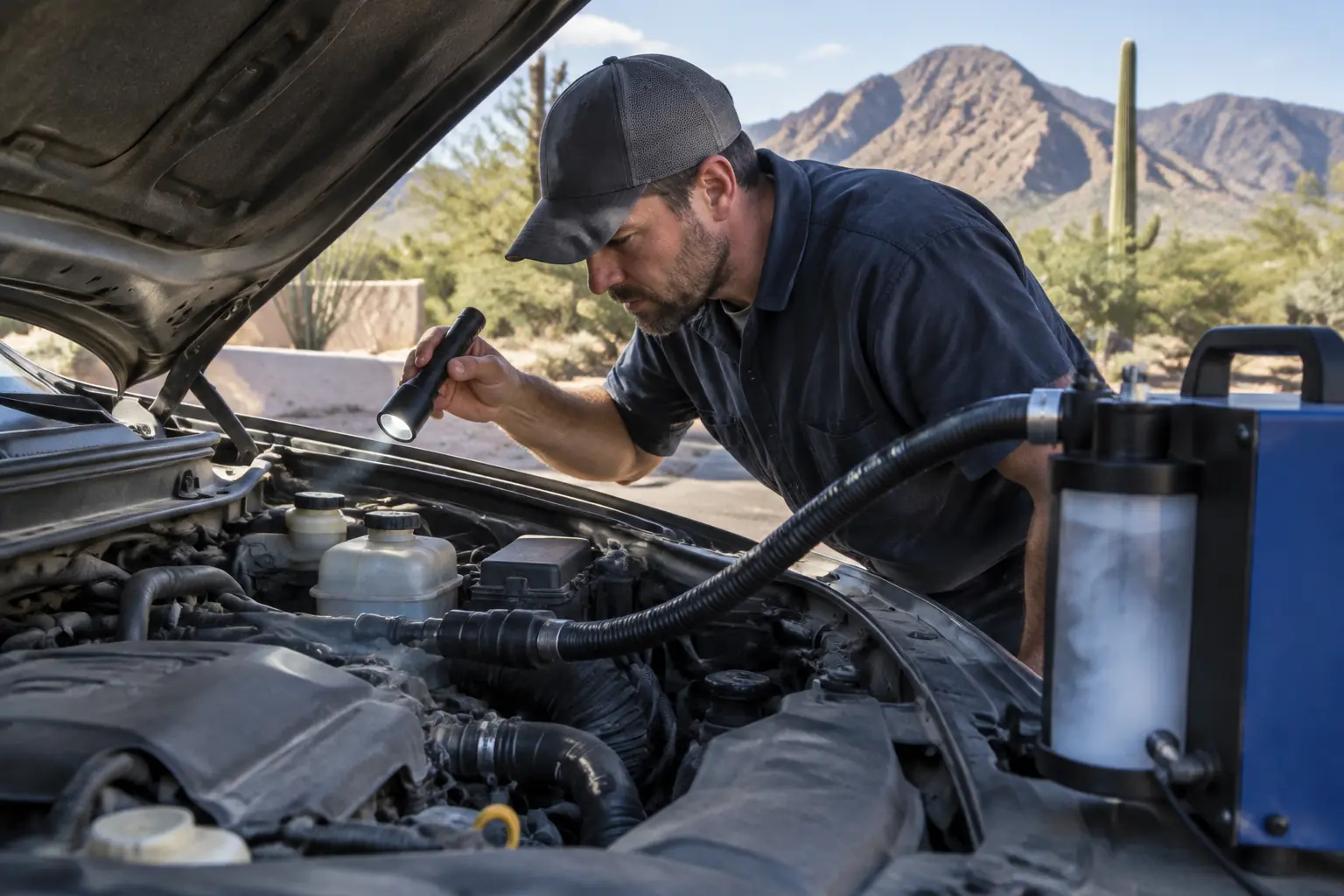
The Mando Guild brings a stocked service van to your home, workplace, or roadside location within our service area. We do not operate a walk-in shop. For an emissions-related concern, we start with your symptoms, the registration timeline, any inspection report, and recent repairs. Knowing that someone cleared codes yesterday changes how we interpret today's scan.
Our diagnostic process includes checking available fault information, the computer's warning-light status, and readiness monitors. We use the findings to guide the applicable electrical, mechanical, or system checks rather than immediately ordering a sensor named in a code. Every job starts with a diagnosis and a written estimate, and nothing is replaced until you approve it. We service most makes and models.
After an approved repair, we explain the relevant verification steps and whether additional operation or another readiness check is needed. A mobile scan cannot guarantee the result of a later state inspection, and it does not replace that inspection. You can request mobile diagnostics in Tucson to establish a repair plan before committing another trip to an emissions station.
How to handle a failed or not-ready inspection
If you have already visited a testing station, keep the complete report. A failure associated with an emissions fault calls for a different response than an inspection that cannot proceed because readiness is incomplete. Follow the report and the current myAZcar instructions for the applicable next steps, including any retest requirements. Avoid relying on remembered rules from an earlier registration cycle.[1]
Bring that report into the diagnosis instead of asking only to have the light turned off. The details can show what the station observed and help establish a useful starting point. If readiness is the issue, explain recent battery work and driving history. If a fault is present, preserve the codes until the mechanic has recorded the relevant diagnostic information.
Emissions repairs have a purpose beyond getting through a registration task. Vehicle emissions contribute to air pollution, and emissions-control systems help reduce that impact.[5] Correcting an actual engine performance problem can also improve fuel economy, although the result depends on the problem and repair.[6] Neither benefit justifies guessing at parts. The goal is a verified repair followed by a valid inspection.
Make your next emissions station visit a planned one
Before heading out, confirm the current station instructions and check that you have the information the program requests. If the vehicle recently had an emissions repair or battery disconnect, establish its readiness status instead of relying on the absence of a warning light. The current myAZcar guidance remains the authority on what your vehicle needs for its test.[1]
Keep your repair paperwork and inspection report together. Ask what was diagnosed, what was repaired, whether codes were cleared, and which readiness checks were completed afterward. Clear answers make it easier to distinguish a resolved problem from one that still needs verification. If the light returns on the way to testing, contact the mechanic rather than clearing it in the parking lot.
For Tucson drivers, the reliable sequence is diagnosis, an approved repair when needed, readiness verification, and the official inspection. The Mando Guild can help with the diagnostic and repair portion at your location, without a trip to a walk-in shop. Call (520) 704-0441 or request service Monday through Friday, 8 a.m. to 5 p.m., to plan your next step.
Sources
- Arizona Department of Environmental Quality, "myAZcar Vehicle Emissions Program." myazcar.com/ (opens in a new tab)
- AAA, "Car Battery Maintenance: 9 Expert Tips to Extend Battery Life." www.aaa.com/autorepair/articles/car-battery-maintenance-9-expert-tips-to-extend-battery-life (opens in a new tab)
- National Weather Service, Tucson, "NWS Tucson Forecast Office." www.weather.gov/twc/ (opens in a new tab)
- Car Care Council, "Don't Let the Check Engine Light Turn You Off From Making Needed Repairs." media.carcare.org/2018-05-01-Dont-Let-the-Check-Engine-Light-Turn-You-Off-From-Making-Needed-Repairs (opens in a new tab)
- U.S. Environmental Protection Agency, "Smog, Soot, and Other Air Pollution from Transportation." www.epa.gov/transportation-air-pollution-and-climate-change/smog-soot-and-other-air-pollution-transportation (opens in a new tab)
- U.S. Department of Energy, FuelEconomy.gov, "Keeping Your Vehicle in Shape." www.fueleconomy.gov/feg/maintain.jsp (opens in a new tab)
FAQ
Quick answers
Keep reading
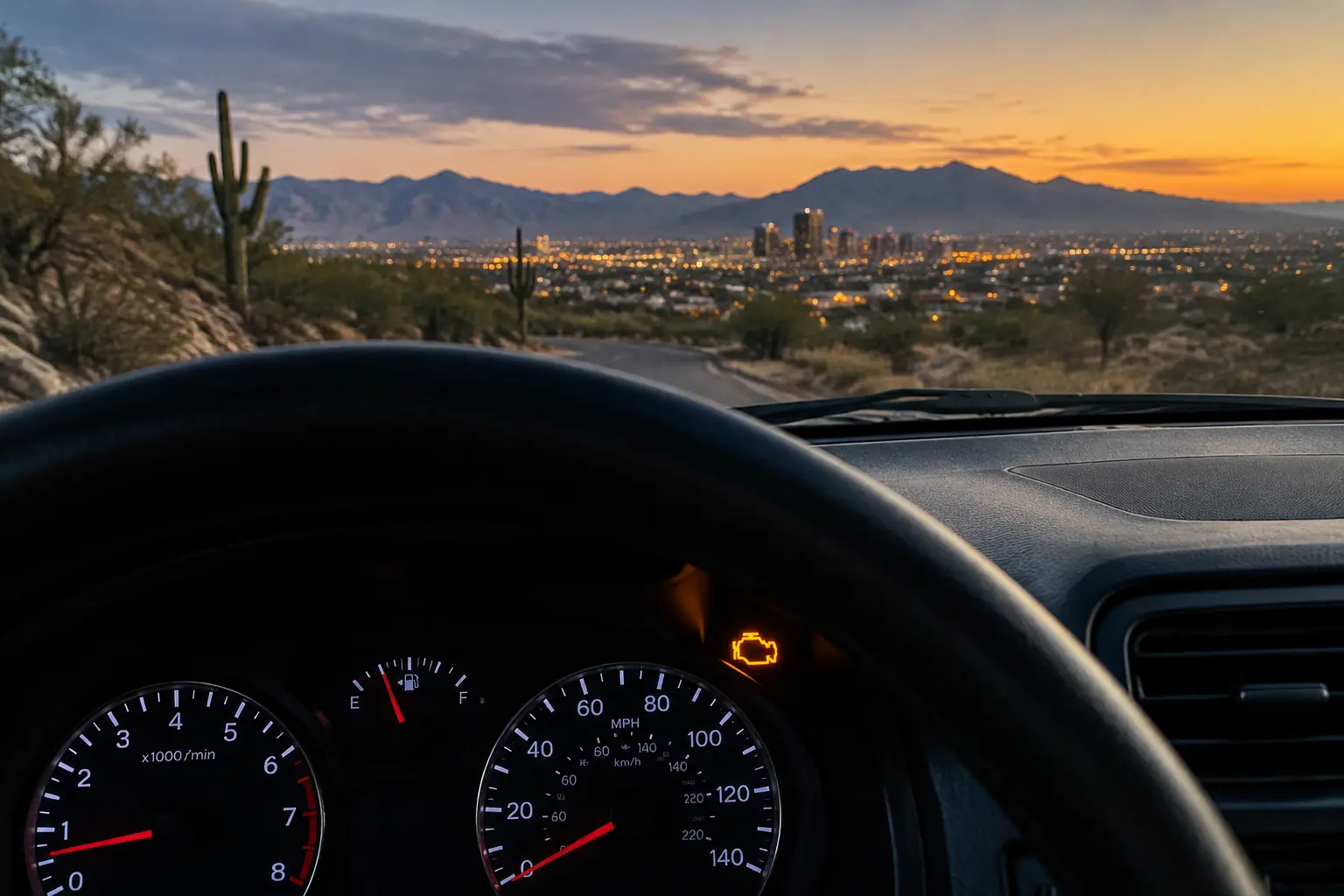 Pillar guideCheck Engine Light in Tucson: What It Means and What to DoUnderstand solid and flashing check engine lights, Tucson driving conditions, emissions testing, and mobile diagnosis at your location.Read more: Check Engine Light in Tucson: What It Means and What to Do →
 9 min readFlashing Check Engine Light in Tucson: Your Next Five MinutesLearn when to stop, how to protect your catalytic converter, and who to call when your check engine light flashes in Tucson.Read more: Flashing Check Engine Light in Tucson: Your Next Five Minutes →
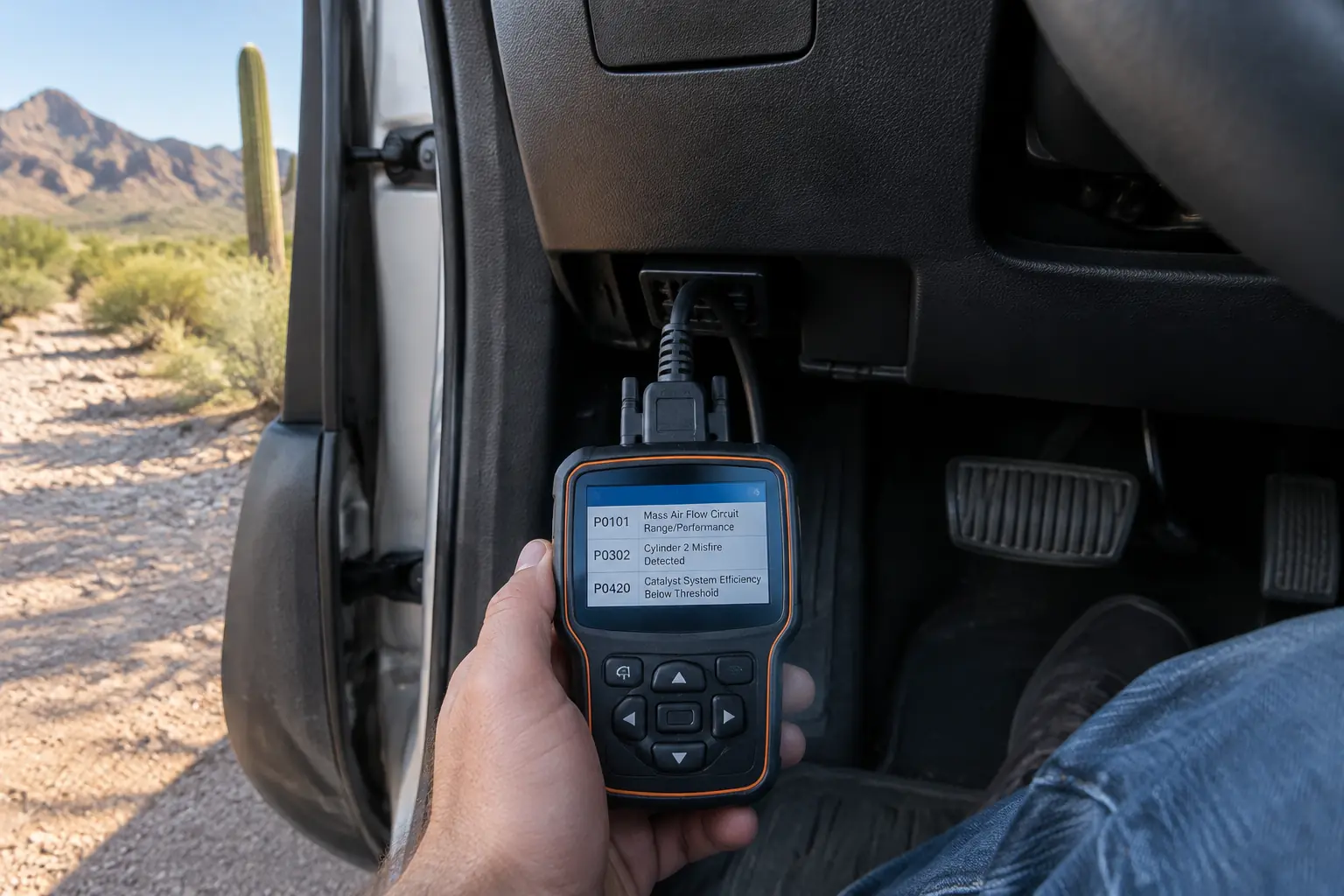 9 min readOBD-II Trouble Codes Explained for Tucson DriversLearn what OBD-II codes tell Tucson drivers, what freeze-frame data adds, and why a scan alone cannot identify the repair.Read more: OBD-II Trouble Codes Explained for Tucson Drivers →