
Check engine & diagnostics · Guide
OBD-II Trouble Codes Explained for Tucson Drivers
9 min readBy The Mando Guild mechanics
OBD2 code reading in Tucson is the retrieval of stored vehicle fault codes to help explain a check engine light or operating problem. The Mando Guild helps you move from that initial clue to a diagnosis at your location, with a written estimate and your approval before anything is replaced.
What an OBD-II scan actually tells you
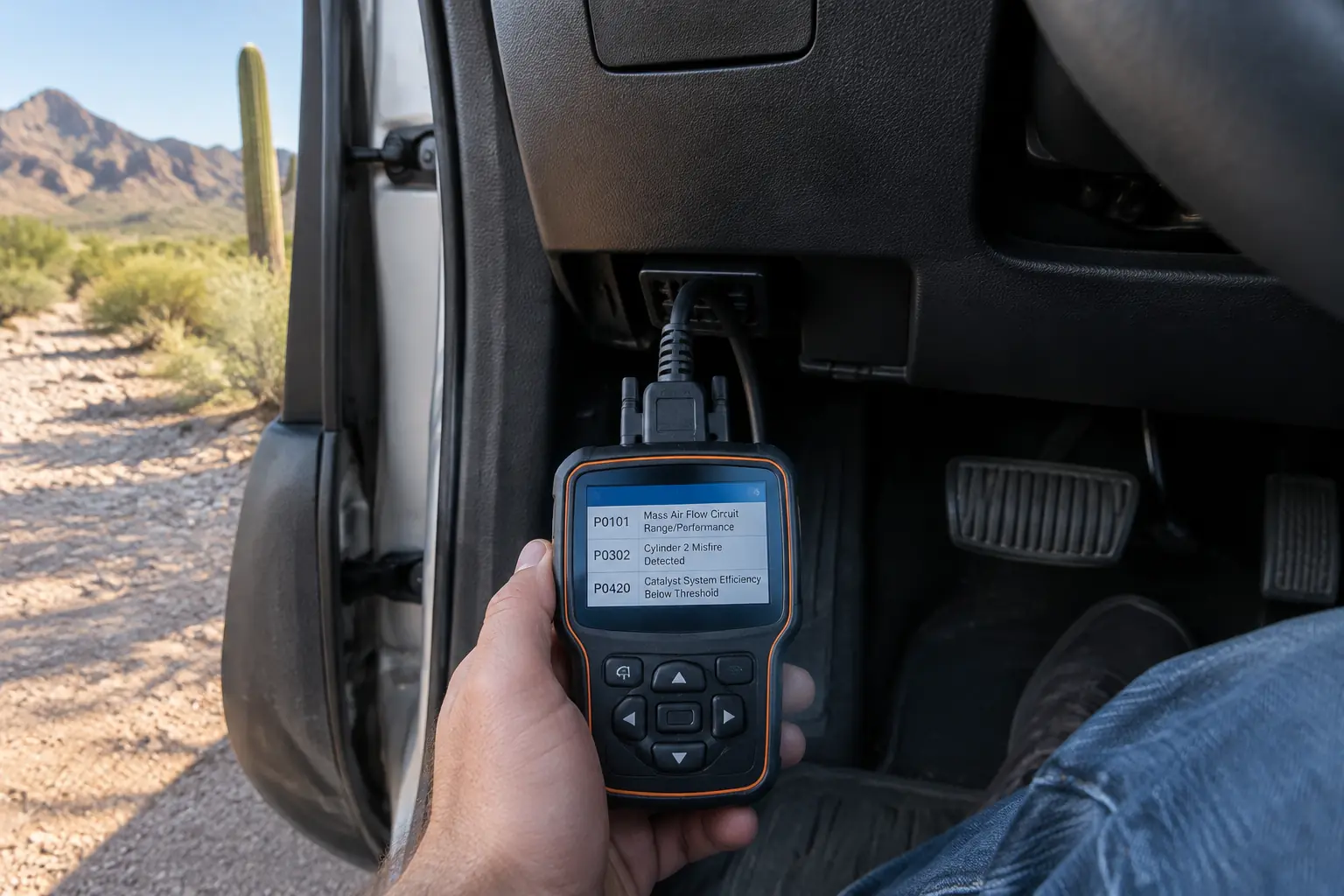
OBD-II means on-board diagnostics, second generation. On most U.S. passenger vehicles from model year 1996 onward, it provides a standardized way to retrieve emissions-related diagnostic information. A vehicle computer stores a diagnostic trouble code, often shortened to DTC, when a monitored condition meets its fault criteria. The check engine light alerts you to an issue that deserves attention, rather than identifying the replacement part.[1]
Think of a code as a report about something the computer observed. It might describe an electrical signal outside its expected range, combustion that was inconsistent, or an emissions system that did not perform as expected. The computer sees signals and test results. It cannot always tell whether the underlying cause is a damaged component, a wiring problem, a leak, or another condition affecting that system.
That distinction matters when you receive a printout with a component name on it. The name tells you where the investigation begins, not where your money must go. Our Tucson check engine light guide covers the broader warning-light picture. Here, the focus is understanding the information behind the light so you can make a better repair decision.
How to read the letters P, B, C, and U
A conventional trouble code has five characters: a letter followed by four digits. The opening letter identifies a broad system family. P means powertrain, which includes engine and transmission functions. B means body, covering systems such as occupant restraints and certain cabin electronics. C means chassis, including functions associated with braking and steering. U means network communication or related vehicle integration faults.
The next character helps distinguish standardized definitions from manufacturer-controlled definitions. A P0 code generally has a standardized meaning, while a P1 code is generally manufacturer-specific. Other ranges have their own allocation rules, so avoid assuming that one shortcut decodes every possible code. The remaining characters narrow the monitored function and specific fault. Always look up the complete code for the correct vehicle, engine, and model year.
For example, P0302 identifies a detected misfire in cylinder 2. It does not say that cylinder 2 needs an ignition coil. Also, a basic emissions reader may retrieve P codes without accessing the modules that hold B, C, or U codes. Sharing the same diagnostic connector does not mean every scanner has access to every system.
Why a named component is not a confirmed diagnosis
A sensor-related code can appear because the sensor failed, but it can also result from damaged wiring, a poor connection, an incorrect supply voltage, or a genuine operating condition the sensor correctly detected. Replacing the named part without testing those possibilities turns a useful clue into a guess. A sound repair decision depends on finding the cause of the complaint, not simply matching a code to a parts listing.[2]
Consider P0171, commonly described as a system-too-lean condition on bank 1. Depending on the vehicle, the investigation might involve unmetered intake air, fuel delivery, sensor information, or an exhaust leak affecting feedback. Those possibilities call for different checks. Similarly, a catalyst-efficiency code does not automatically prove that a catalytic converter should be replaced before related conditions are evaluated.
This is why a responsible estimate follows diagnosis instead of preceding it. You should be able to ask what failed, what evidence supports that conclusion, and whether another fault contributed to it. If a misfire code is your starting point, our article on finding the cause of rough idle and misfires explains that separate diagnostic path without treating every misfire as the same repair.
Freeze-frame data preserves the conditions behind a code
Freeze-frame data is a saved snapshot of selected operating values associated with a detected fault. Depending on the vehicle and fault, it may include engine speed, vehicle speed, coolant temperature, calculated engine load, and fuel-trim readings. Instead of merely saying that something went wrong, it helps show what the engine was doing when the computer recorded the event.
That context can change the next test. A fault recorded before the engine warmed up points toward different operating conditions than one recorded under load after a long drive. A lean-condition code at idle may guide a different investigation than the same code during acceleration. Freeze-frame values are evidence to interpret together, not separate pass-or-fail verdicts on individual parts.
The snapshot has limits. Not every module or code provides the same data, and it is not a continuous recording of your trip. Available records may be limited or prioritized by the vehicle. Ask for the freeze-frame information to be saved with the code report before anyone clears faults. Your own notes about symptoms fill gaps that the electronic snapshot cannot capture, such as a recent repair or an intermittent odor.
Pending, confirmed, and permanent codes mean different things
A pending code generally means a monitor detected a potential fault that has not yet met the criteria for a confirmed code. It can be useful when a symptom has started but the check engine light is not staying on. A confirmed code means the applicable confirmation criteria were met, although the exact detection and warning-light logic vary by fault and vehicle.
Permanent emissions-related codes, on vehicles that support them, work differently. A scanner or battery disconnection generally cannot erase them on demand. The vehicle must run the relevant monitoring process and determine that the fault is no longer present before clearing the permanent record. A permanent code therefore needs to be interpreted alongside current faults, monitor results, and repair history.
Readiness status is another piece of information, not another trouble code. It reports whether supported emissions self-tests have completed. Clearing codes can reset readiness monitors and make an emissions inspection more complicated. Arizona's myAZcar program provides the applicable testing and readiness guidance.[3] If an inspection is approaching, read our Arizona emissions testing and check engine light explanation rather than assuming that an erased light means the vehicle is ready.
Free scans versus professional diagnosis in Tucson
A parts-store free scan, where offered, can be a useful starting point. It may give you the stored code numbers and brief descriptions without requiring you to purchase a scanner. Available services vary by location, so ask what the scan includes. A printout can help you describe the problem, but a suggested part on that printout is not evidence that the part failed.
Professional diagnosis adds interpretation and targeted testing. Depending on the complaint, that can include examining live data, checking electrical circuits, comparing commanded operation with actual response, or testing for a leak. The technician uses the vehicle's service information and the conditions behind the fault to choose those checks. General car-care guidance distinguishes understanding a problem from simply buying replacement parts.[4]
The useful comparison is not free information versus paid information. It is code retrieval versus work that establishes a cause. Ask whether the service includes more than reading and clearing codes, and what findings you will receive. A cheap reader can retrieve a valuable clue, while an expensive scanner can still produce a poor conclusion if nobody verifies what the clue means.
Tucson heat and changing conditions add diagnostic context
Summer highs in Tucson regularly exceed 100 degrees F, and the official monsoon season runs from June 15 through September 30.[5] Those conditions make timing worth recording. Tell your mechanic whether the problem appeared after outdoor parking, during stop-and-go driving on Grant Road, or shortly after rain. These observations help define the conditions to investigate without making weather the automatic explanation.
For example, an electrical complaint after a hot soak deserves attention to the actual voltage and connection condition, not an immediate battery replacement. Heat can contribute to battery deterioration, but battery condition still needs to be evaluated.[6] Likewise, a fault after rain may justify checking relevant connectors for moisture, but the timing alone does not prove water caused it.
Keep your notes specific and brief. Record whether the engine was cold or warm, whether the air conditioning was running, and whether the symptom happened at idle or while accelerating. You do not need to recreate a risky situation on I-10 or drive through standing water to gather evidence. The goal is to connect your observations with stored data, not to force the fault to happen again.
What to save before anyone clears the codes
Save the complete code numbers, their status, and any available freeze-frame report. A screenshot is often easier to share than a remembered description such as 'something about the oxygen sensor.' Include the vehicle's year, make, model, engine if known, and the symptoms you noticed. Mention recent repairs, a jump start, or a disconnected battery because those events can affect how the information is interpreted.
Avoid clearing codes simply to see whether the light returns before the original information has been recorded. Clearing may remove useful fault context and reset emissions readiness. It also does not fix the operating problem. Addressing an actual engine-performance fault, rather than hiding its warning, can help restore proper operation and fuel economy.[7]
Do not let a scan override obvious safety concerns. If the engine is shaking badly, the check engine light is flashing, or the vehicle cannot maintain safe operation, stop driving when you can safely do so and arrange help. Our flashing check engine light action guide addresses that immediate decision. A code description on your phone cannot establish that a struggling vehicle is safe to continue driving.
How The Mando Guild investigates codes on-site
The Mando Guild brings a stocked service van to your home, workplace, or roadside location in greater Tucson. Our registered hub is in Flowing Wells, but we do not have a walk-in shop. For a diagnostic visit, the starting point is your complaint: what changed, when it happens, and what information has already been collected. We work on most makes and models.
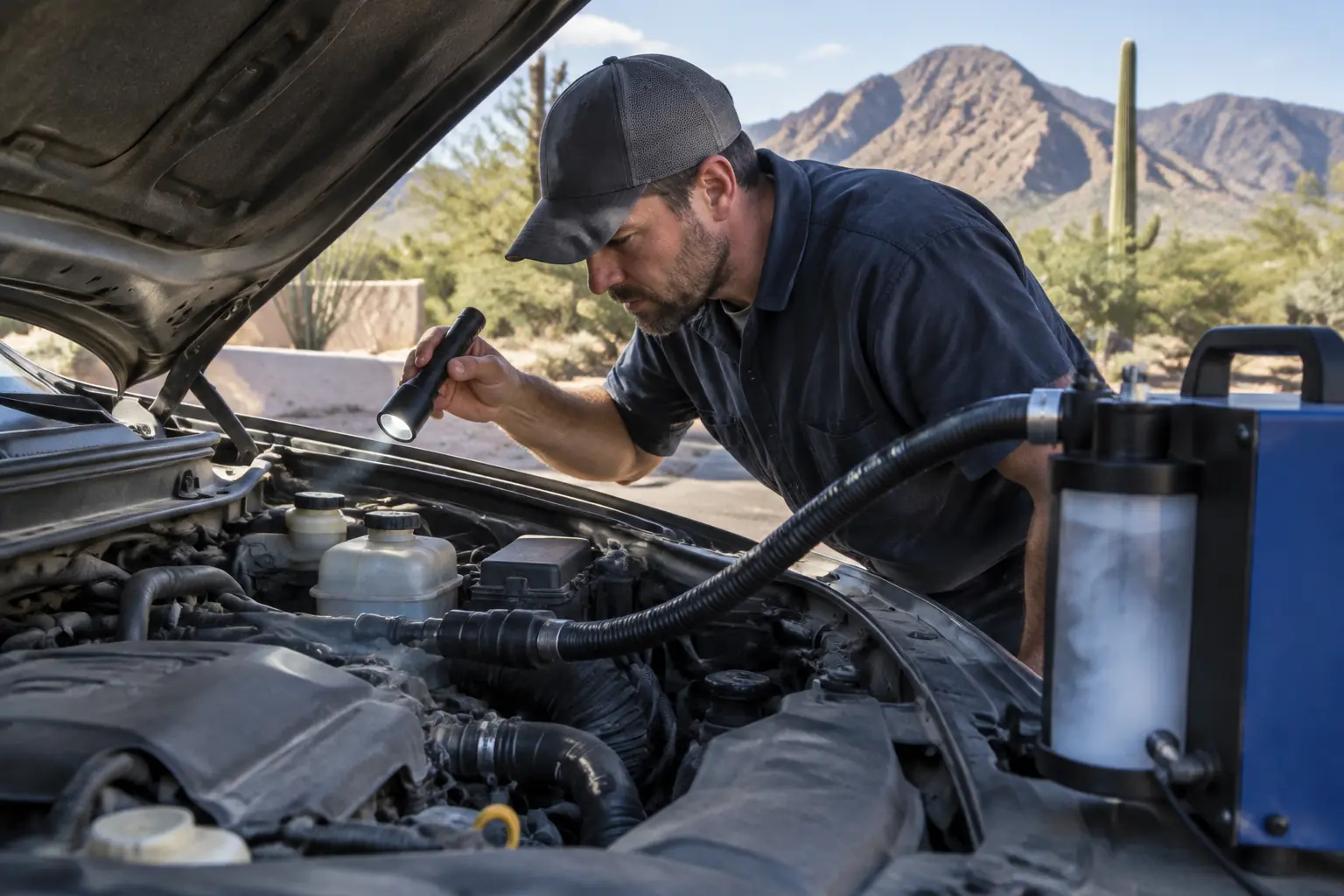
We review the available fault information and use the symptoms to guide the checks. Depending on the vehicle and concern, those checks can involve freeze-frame information, live readings, accessible wiring and connectors, battery voltage, or the system named by the code. The purpose is to separate a failed component from a condition affecting it. Scan access and available tests depend on the vehicle and its systems.
Every job starts with a diagnosis and a written estimate. Nothing is replaced until you approve it. If the concern is intermittent or further testing is needed, that uncertainty belongs in the explanation rather than being disguised as a confirmed repair. You can request mobile diagnostics in Tucson and share any existing scan report so the visit starts with the information you already have.
What a useful diagnostic result should leave you with
At the end of the investigation, you should understand more than the definition of a code. A useful explanation connects the complaint, the stored evidence, the test findings, and the recommended next step. If a part is recommended, ask how its failure was established. If several codes are present, ask whether one underlying problem could explain more than one of them.
Verification matters, too. Depending on the repair, confirmation may involve checking live readings, repeating a functional test, or allowing the appropriate monitor to run under specified conditions. Turning the light off is not the same as proving the problem is resolved. Some faults require more observation, and some readiness monitors will not complete during a short idle in the driveway.
You do not need to become a scan-tool expert to make a sound decision. Keep the original report, describe the symptom clearly, and expect a recommendation supported by evidence. That approach makes code reading useful instead of expensive guesswork. Call The Mando Guild at (520) 704-0441 or request service Monday through Friday, 8 a.m. to 5 p.m.; roadside help is available only during those business hours.
Sources
- Car Care Council, "Don't Let the Check Engine Light Turn You Off From Making Needed Repairs." media.carcare.org/2018-05-01-Dont-Let-the-Check-Engine-Light-Turn-You-Off-From-Making-Needed-Repairs (opens in a new tab)
- Consumer Reports, "Car Maintenance and Repair Guide." www.consumerreports.org/cars/car-maintenance-and-repair-guide/ (opens in a new tab)
- Arizona Department of Environmental Quality, "myAZcar Vehicle Emissions Program." myazcar.com/ (opens in a new tab)
- Edmunds, "Car Maintenance." www.edmunds.com/car-maintenance/ (opens in a new tab)
- National Weather Service, Tucson, "NWS Tucson Forecast Office." www.weather.gov/twc/ (opens in a new tab)
- AAA, "Car Battery Maintenance: 9 Expert Tips to Extend Battery Life." www.aaa.com/autorepair/articles/car-battery-maintenance-9-expert-tips-to-extend-battery-life (opens in a new tab)
- U.S. Department of Energy, FuelEconomy.gov, "Keeping Your Vehicle in Shape." www.fueleconomy.gov/feg/maintain.jsp (opens in a new tab)
FAQ
Quick answers
Keep reading
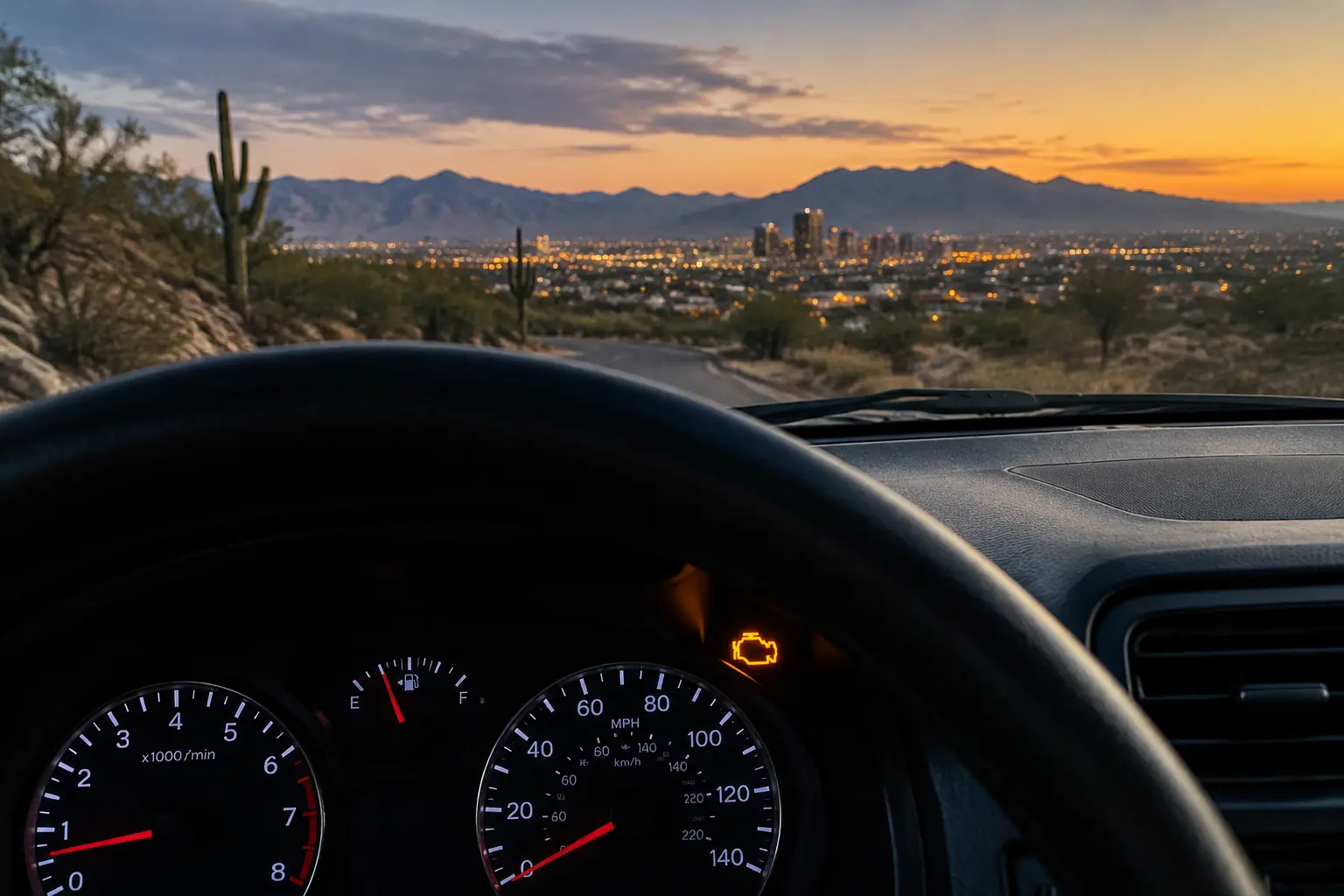 Pillar guideCheck Engine Light in Tucson: What It Means and What to DoUnderstand solid and flashing check engine lights, Tucson driving conditions, emissions testing, and mobile diagnosis at your location.Read more: Check Engine Light in Tucson: What It Means and What to Do →
 9 min readFlashing Check Engine Light in Tucson: Your Next Five MinutesLearn when to stop, how to protect your catalytic converter, and who to call when your check engine light flashes in Tucson.Read more: Flashing Check Engine Light in Tucson: Your Next Five Minutes →
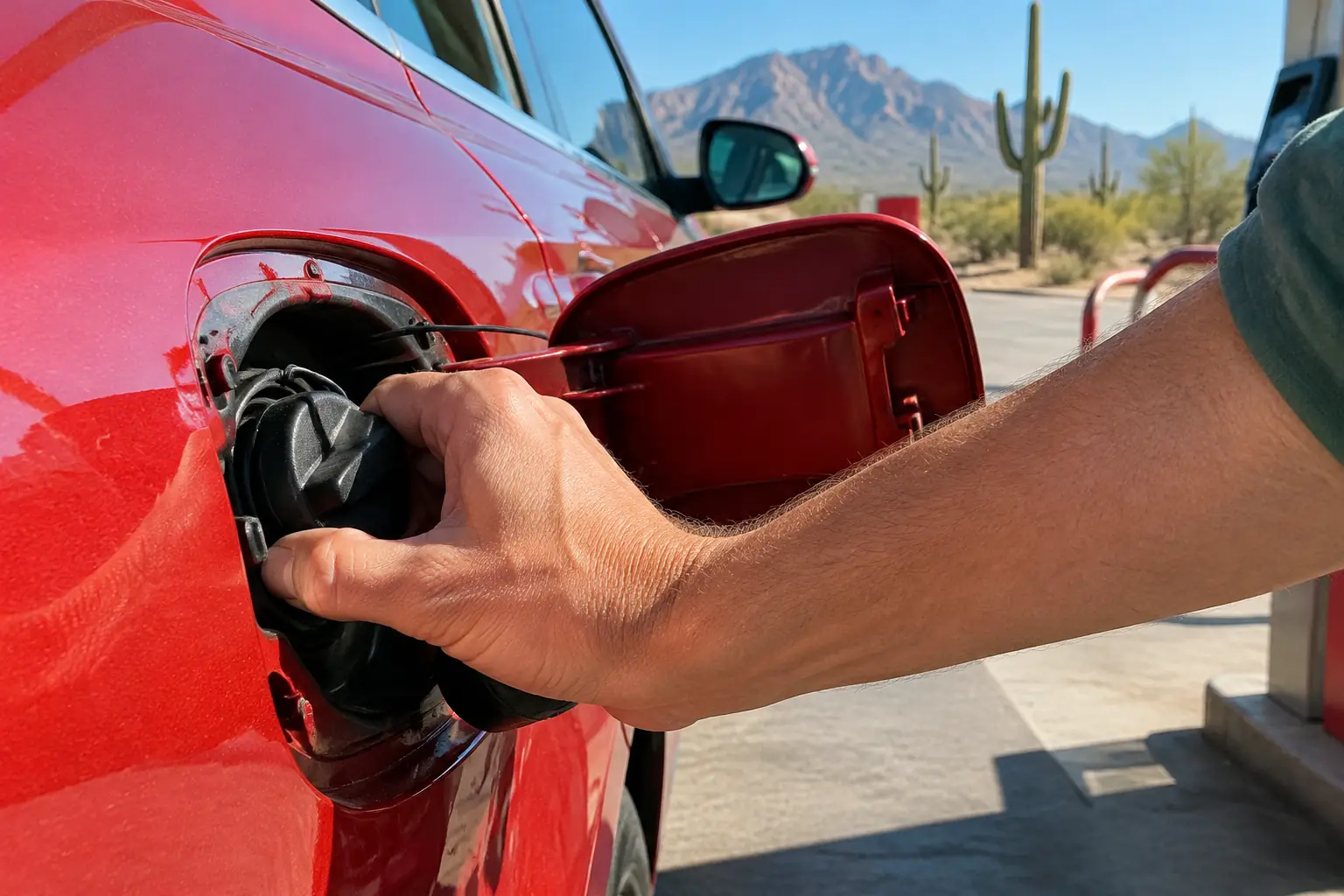 9 min readLoose Gas Caps and EVAP Warning Lights in Tucson HeatLearn why Tucson heat exposes EVAP problems, what P0455 and P0456 mean, and how testing separates a loose cap from another leak.Read more: Loose Gas Caps and EVAP Warning Lights in Tucson Heat →