
Check engine & diagnostics · Guide
Rough Idle and Misfires in Tucson: Finding the Real Cause
9 min readBy The Mando Guild mechanics
A rough idle or engine misfire in Tucson is uneven engine operation that needs testing, not a guess at which part to replace. The Mando Guild helps Tucson car owners trace the problem through ignition, fuel delivery, air leaks, and compression, then provides a written estimate before any approved replacement.
A rough idle is a symptom, not a parts order
An engine should produce a reasonably steady rhythm at idle. When one cylinder contributes less power than the others, you may feel shaking through the seat, steering wheel, or body. A misfire means combustion in a cylinder is missing or incomplete. The cause can involve spark, fuel, air, or the mechanical ability to build compression. Replacing whichever component seems familiar skips the question that matters: Why is that cylinder failing to contribute?
Not every vibration is a combustion problem. An engine mount can transmit otherwise normal engine movement into the cabin, and an accessory load can change how the engine feels. The first task is to separate actual uneven combustion from a vibration that merely resembles it. Misfire data, engine speed, operating conditions, and a physical inspection help make that distinction without treating every shake as a bad coil.
This is different from scheduled maintenance. Spark plugs may be due by mileage, but an overdue service item does not automatically explain your current symptom. Follow the vehicle's maintenance schedule while treating a new running problem as a separate diagnostic question.[1] Our explanation of modern tune-ups covers routine service rather than fault isolation.
Know when a Tucson misfire needs you to stop
A flashing check engine light can indicate a severe misfire that threatens the catalytic converter.[2] If it flashes while the engine shakes, avoid hard acceleration, move out of traffic when safe, and shut the engine off in a safe location. Do not keep driving around to see whether the problem clears. The difference between a steady warning and a flashing one matters more than how close you are to home.
A steady light is not permission to ignore pronounced shaking, stalling, or major power loss. If the vehicle cannot maintain safe operation, arrange help rather than attempting the next stretch of Oracle Road or I-10. A strong raw-fuel smell is another reason to stop testing the engine yourself. Never run an engine in an enclosed garage while trying to reproduce an idle problem.
Keep the immediate safety decision separate from the repair decision. You do not need to identify the failed part before deciding that driving is unsafe. Our flashing check engine light guide explains the immediate response. Once the vehicle is safely parked, diagnosis can focus on the cause rather than adding damage or exposing you to traffic.
Start with the conditions that trigger the problem
Your description can narrow the test plan before a tool touches the vehicle. Does the engine shake only on the first start, after warming up, with the air conditioning running, or during acceleration? Does it smooth out above idle? A problem that appears at a stoplight may require a different approach from one that occurs only under load. Tell us what you observed rather than trying to name the failed component.
Recent events matter, too. Mention repairs, a battery disconnect, a refueling stop, or work around the intake system. These details do not prove causation, but they identify connections, hoses, or operating conditions worth checking. If the symptom is intermittent, a short record of when it happens is useful. Record observations only when safely parked, and do not deliberately provoke a severe misfire.
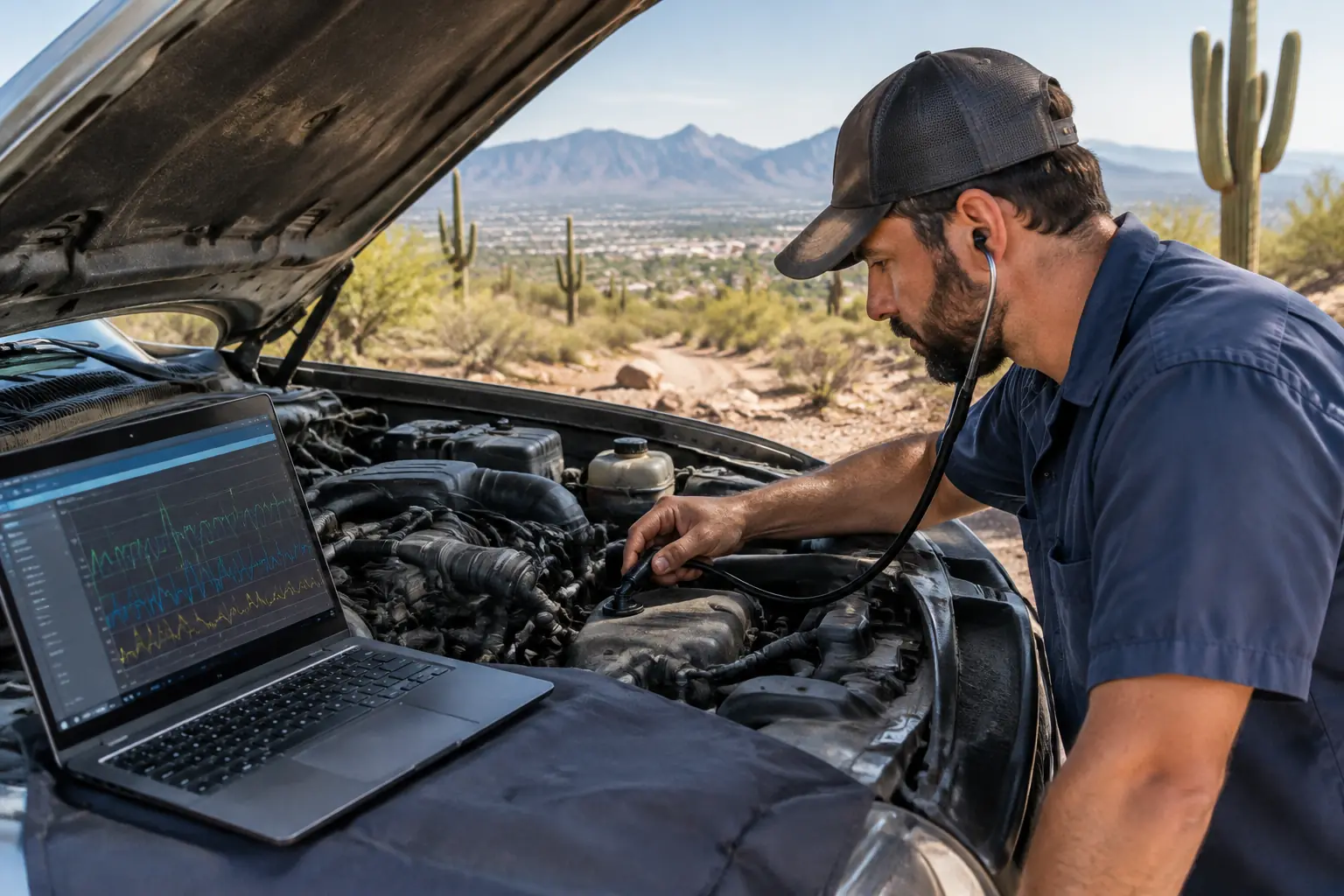
The initial scan should preserve stored and pending codes and available freeze-frame information before anything is cleared. Freeze-frame data captures selected operating conditions when a fault was recorded. Clearing codes too soon can remove useful context. For the broader warning-light process, see our Tucson check engine light guide. Here, the focus stays on using that information to choose the next physical test.
Read cylinder patterns before testing individual parts
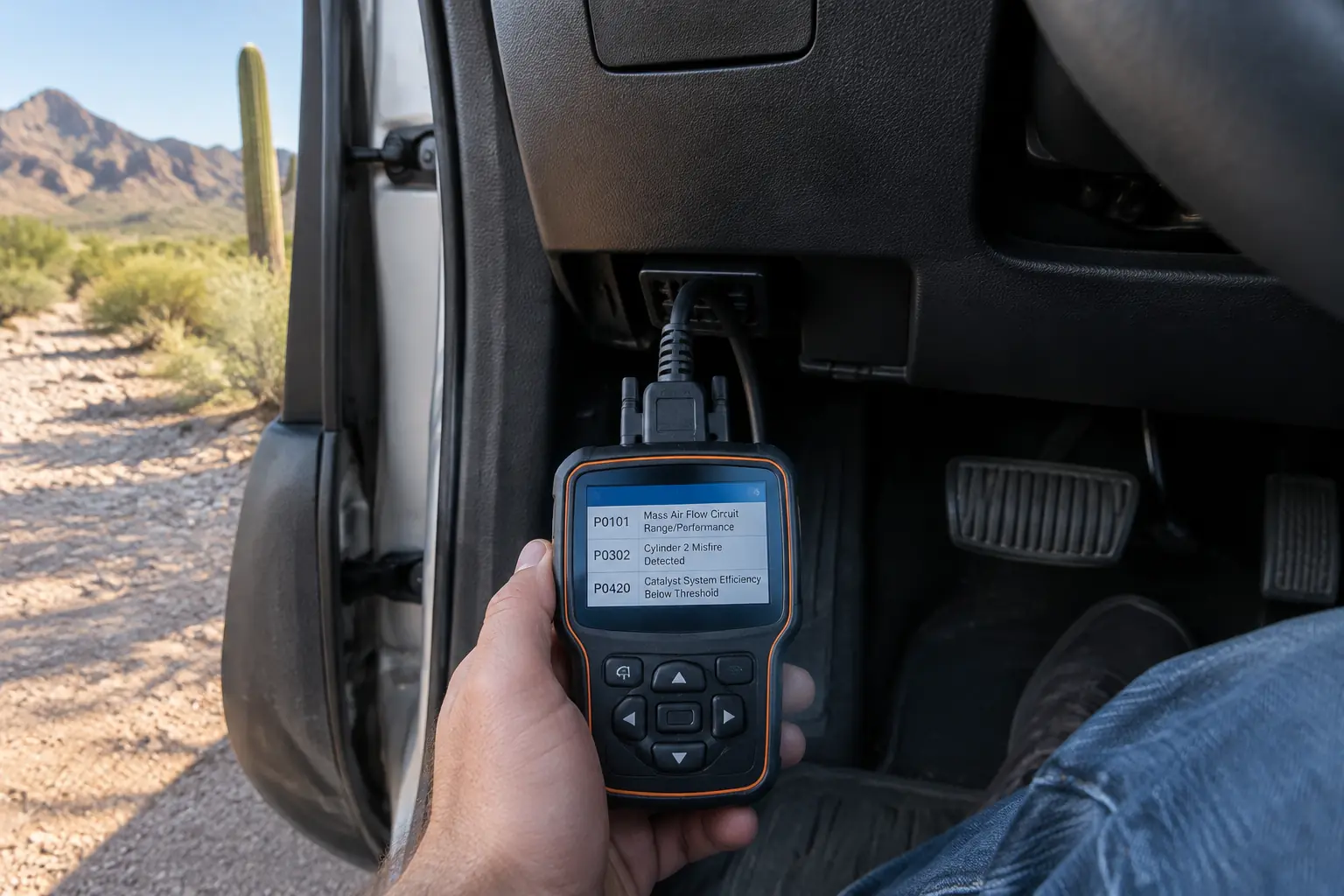
A P0300 code describes a random or multiple-cylinder misfire, while codes such as P0301 point toward a particular cylinder. Neither code identifies the failed part. A cylinder-specific fault could come from a plug, coil, injector, wiring problem, or compression loss. Our guide to OBD-II trouble codes explains why a code is a starting point rather than a replacement instruction.
Where the vehicle supports it, misfire counters help show which cylinders are affected and when. Fuel trims provide another clue by showing how the engine computer is adjusting fueling. Large positive corrections can suggest that the computer is compensating for a lean condition, but they do not prove a vacuum leak. Fuel supply problems and misleading sensor inputs can produce overlapping clues.
The sequence is guided by evidence, not a rigid checklist that requires every possible test. A disconnected hose deserves attention before an involved injector test. A persistent single-cylinder fault may justify checking ignition and compression early. Comparing behavior at idle and under appropriate controlled conditions helps avoid interpreting one scan-tool number in isolation. The goal is to choose the test most likely to separate the remaining explanations.
Test plugs and coils without guessing
Ignition inspection includes the spark plug, coil boot, electrical connector, and accessible wiring. A worn electrode, damaged insulator, carbon tracking, or contamination in a plug well can provide a useful lead. Spark plugs need replacement according to the vehicle's requirements, but a fault investigation also asks why a plug looks abnormal.[3] An oil-fouled plug, for example, may be evidence of another problem rather than the whole repair.
On suitable engines with individual coils, a controlled coil swap can help isolate a fault. If the misfire consistently moves with the coil, that supports an ignition diagnosis. If it stays on the original cylinder, the investigation continues. This test is not appropriate for every ignition layout, and a result should be checked against connector condition and the circumstances under which the misfire occurs.
A plug that looks acceptable can still perform poorly under load, so appearance alone is not a complete test. Depending on the vehicle, electrical testing or waveform analysis may be more useful than swapping parts. We do not treat one failed coil as automatic proof that every coil needs replacement. Any broader recommendation should distinguish a confirmed failure from scheduled maintenance or a related condition you can review.
Separate vacuum leaks from fuel delivery faults
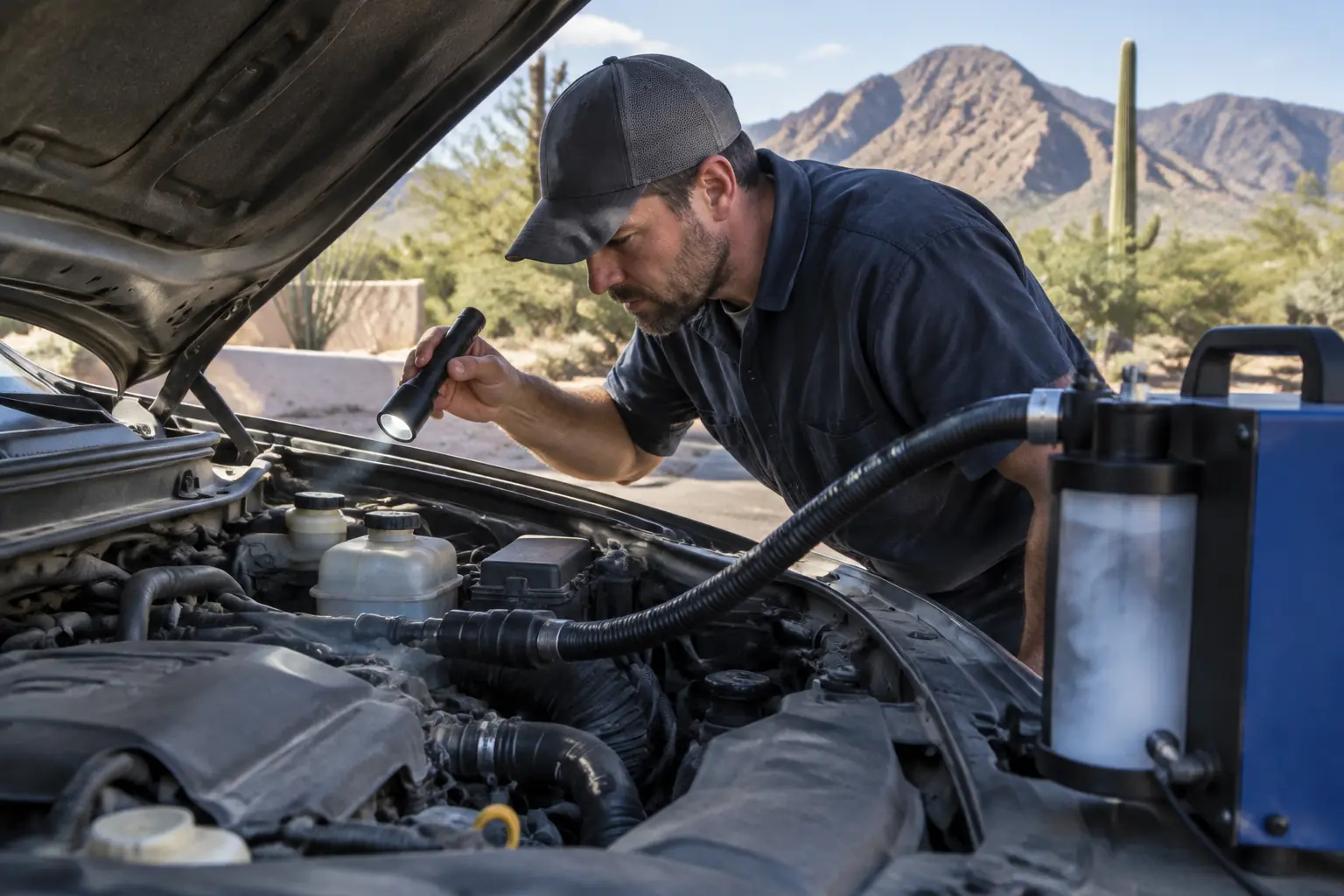
Unmetered air entering the intake can upset the air-fuel mixture, particularly at idle. Split hoses, intake sealing problems, and faults in connected ventilation or purge systems are possible paths. Inspection and an appropriate smoke test can help locate leakage instead of relying on sound alone. Changes in fuel trims between idle and a higher engine speed can support the investigation, but those changes still need confirmation.
Fuel delivery takes a different branch of testing. An injector may have an electrical fault, restricted flow, or leakage. Hearing it click does not prove that it delivers the correct amount of fuel. Depending on the system, useful checks may include the command signal, circuit integrity, pressure behavior, or an injector balance test. A problem affecting several cylinders can also point toward shared fuel supply rather than several failed injectors.
These checks require attention to system design, especially with high-pressure direct injection. Do not loosen fuel lines or spray flammable products around a running engine to hunt for a leak. Professional diagnosis is meant to narrow the cause before repair, not substitute one unverified part for another. Reliable repair guidance emphasizes understanding the problem and the proposed work before authorizing it.[4]
Check compression when spark and fuel do not explain it
A cylinder needs to seal well enough to compress its charge. If ignition and fuel checks do not explain a persistent misfire, compression testing helps assess the mechanical side. Depending on the symptoms, this check may belong earlier in the sequence. Repeatedly replacing a plug that fouls in the same cylinder makes little sense without asking whether that cylinder has an underlying mechanical problem.
A relative compression test can identify an imbalance that needs closer investigation. A conventional compression test measures cylinder pressure under specified conditions, and a leak-down test can help locate where sealing is being lost. Results must be interpreted using the engine's specifications and the testing conditions. One low reading does not, by itself, justify declaring that the engine needs replacement.
Possible causes include valve sealing problems, piston or ring damage, and valve timing faults. The diagnostic goal is to distinguish these possibilities well enough to explain the next step. Mechanical repair may require facilities beyond a mobile visit. If the findings point there, you should receive a clear explanation of what has been established, what remains uncertain, and why further testing or shop-based work is appropriate.
Tucson heat and monsoon timing provide useful clues
Tucson summer highs regularly exceed 100 degrees Fahrenheit, and the official monsoon season runs from June 15 through September 30.[5] Those conditions provide useful context, but they are not a diagnosis. A misfire that appears after a hot restart on Grant Road still needs the same evidence-based separation of ignition, fuel, air, and compression faults as a cold-start problem in winter.
Tell us if the symptom starts after the vehicle sits hot, appears during damp weather, or follows recent work around dusty intake components. Temperature-dependent electrical faults and moisture-related ignition problems are possibilities to test, not conclusions to assume. Similarly, dust around an engine does not prove a restricted injector. Specific timing is more useful than a general statement that the desert is hard on cars.
Air conditioning can make an existing idle problem more noticeable because it changes engine load. That does not automatically mean the compressor is faulty. We compare the engine's response with the load on and off when safe and appropriate. Explaining that your vehicle shakes at a Speedway Boulevard stoplight with the air conditioning on gives us a condition to reproduce rather than a component to condemn.
What mobile misfire diagnosis looks like in Flowing Wells
The Mando Guild brings a stocked service van to your home, workplace, or safe roadside location. Our registered hub is in Flowing Wells, but it is not a walk-in shop. For an idle complaint, we start with your symptom history, an initial inspection, and scan information. Access, engine temperature, vehicle design, and the safety of the parking location determine which tests are practical on-site.
The test plan follows what we find. It may include checking ignition components, looking for intake leaks, evaluating injector operation, or investigating compression. We explain the evidence rather than presenting a trouble code as proof of a failed part. Every job starts with a diagnosis and a written estimate, and nothing is replaced until you approve it. If further testing is needed, we explain that before moving ahead.
We service most makes and models and use OEM-grade parts. Mobile access does not mean every internal engine repair can be completed in a driveway, so we discuss any limitations honestly. Our mobile diagnostics service covers greater Tucson, including Flowing Wells, Midtown, Casas Adobes, Oro Valley, and Marana. The purpose of the visit is to turn an uncertain symptom into an informed repair decision.
Verify the repair under the original conditions
A repair is not fully evaluated just because the engine sounds smoother immediately afterward. Verification should revisit the conditions that produced the complaint when it is safe to do so. That may mean checking a warm idle, observing misfire counters, or comparing fuel-trim behavior after an air leak is corrected. An intermittent cold-start problem may require another cold start before confidence in the result is justified.
Clearing a code is not the same as fixing its cause. Correcting an engine running problem can improve efficiency, while leaving it unresolved can continue wasting fuel.[6] We also separate the confirmed repair from any remaining symptoms. If a mount vibration remains after combustion is stable, that deserves its own explanation rather than another round of ignition parts.
When arranging engine misfire repair in Tucson, share the year, make, model, symptoms, and whether the warning light is steady or flashing. That helps plan the visit without pretending to diagnose the vehicle by phone. Call (520) 704-0441 or request service from The Mando Guild Monday through Friday, 8 a.m. to 5 p.m. Roadside help is available only during those business hours.
Sources
- Consumer Reports, "Your Car Maintenance Checklist." www.consumerreports.org/cars/car-repair-maintenance/your-car-maintenance-checklist-a6808357212/ (opens in a new tab)
- Car Care Council, "Don't Let the Check Engine Light Turn You Off From Making Needed Repairs." media.carcare.org/2018-05-01-Dont-Let-the-Check-Engine-Light-Turn-You-Off-From-Making-Needed-Repairs (opens in a new tab)
- Car Care Council, "Car Care Guide." www.carcare.org/car-care-guide/ (opens in a new tab)
- Consumer Reports, "Car Maintenance and Repair Guide." www.consumerreports.org/cars/car-maintenance-and-repair-guide/ (opens in a new tab)
- National Weather Service, Tucson, "NWS Tucson Forecast Office." www.weather.gov/twc/ (opens in a new tab)
- U.S. Department of Energy, FuelEconomy.gov, "Keeping Your Vehicle in Shape." www.fueleconomy.gov/feg/maintain.jsp (opens in a new tab)
FAQ
Quick answers
Keep reading
 Pillar guideCheck Engine Light in Tucson: What It Means and What to DoUnderstand solid and flashing check engine lights, Tucson driving conditions, emissions testing, and mobile diagnosis at your location.Read more: Check Engine Light in Tucson: What It Means and What to Do →
 9 min readFlashing Check Engine Light in Tucson: Your Next Five MinutesLearn when to stop, how to protect your catalytic converter, and who to call when your check engine light flashes in Tucson.Read more: Flashing Check Engine Light in Tucson: Your Next Five Minutes →
 9 min readOBD-II Trouble Codes Explained for Tucson DriversLearn what OBD-II codes tell Tucson drivers, what freeze-frame data adds, and why a scan alone cannot identify the repair.Read more: OBD-II Trouble Codes Explained for Tucson Drivers →