
Maintenance & oil · Guide
What a Tune-up Means for Your Tucson Car Today
9 min readBy The Mando Guild mechanics
A tune-up in Tucson is vehicle-specific maintenance that helps prevent ignition problems, not a standard cure for rough running. The Mando Guild helps you separate scheduled maintenance from needed repairs with an on-site diagnosis, a written estimate, and your approval before anything is replaced.
Why a Tucson tune-up needs a specific parts list
The phrase "tune-up" describes a goal more clearly than a procedure. You want reliable starting, smooth operation, and maintenance that is current. On a modern gasoline vehicle, getting there means checking the manufacturer's schedule and the car's condition rather than buying a universal package. Two vehicles with similar mileage can need different work because their engines, service histories, and specified parts differ.[1]
Start by separating a maintenance request from a symptom complaint. If your engine runs normally and its spark plugs are due, that is scheduled maintenance. If it shakes at stoplights or hesitates when you accelerate, it needs diagnosis. Overdue plugs may be involved, but a tune-up label should never substitute for finding the cause.
Ask what each proposed item accomplishes and why it belongs on your estimate. A useful recommendation identifies the part, the scheduled requirement or finding behind it, and any follow-up checks. For the broader maintenance picture, use our Tucson mobile maintenance guide. Here, the focus is the engine's ignition and related air and fuel service, not a catchall inspection of every vehicle system.
What changed since the carburetor era
Older tune-ups could involve ignition points, a condenser, distributor components, ignition timing adjustments, and carburetor settings. Most modern gasoline vehicles use computer-controlled fuel injection and electronic ignition instead. The engine computer continually manages operating decisions that once required more manual adjustment. That changes what routine service involves, but it does not eliminate maintenance or make worn components repair themselves.[1]
You generally do not need a mechanic to manually adjust the fuel mixture for a routine seasonal tune-up on a modern fuel-injected car. Nor should an older checklist automatically put distributor parts on an engine that does not have a distributor. The correct starting point is identifying your exact engine and its service requirements, not matching an advertisement's bundle.
Another leftover idea is that every tune-up should restore a noticeable amount of power or fuel economy. Correcting a real maintenance problem can improve operation, but servicing an already healthy engine does not guarantee a dramatic change. FuelEconomy.gov connects proper maintenance and repair with efficient operation, rather than promising gains from a generic tune-up package.[2]
Spark plugs are scheduled parts, not universal parts
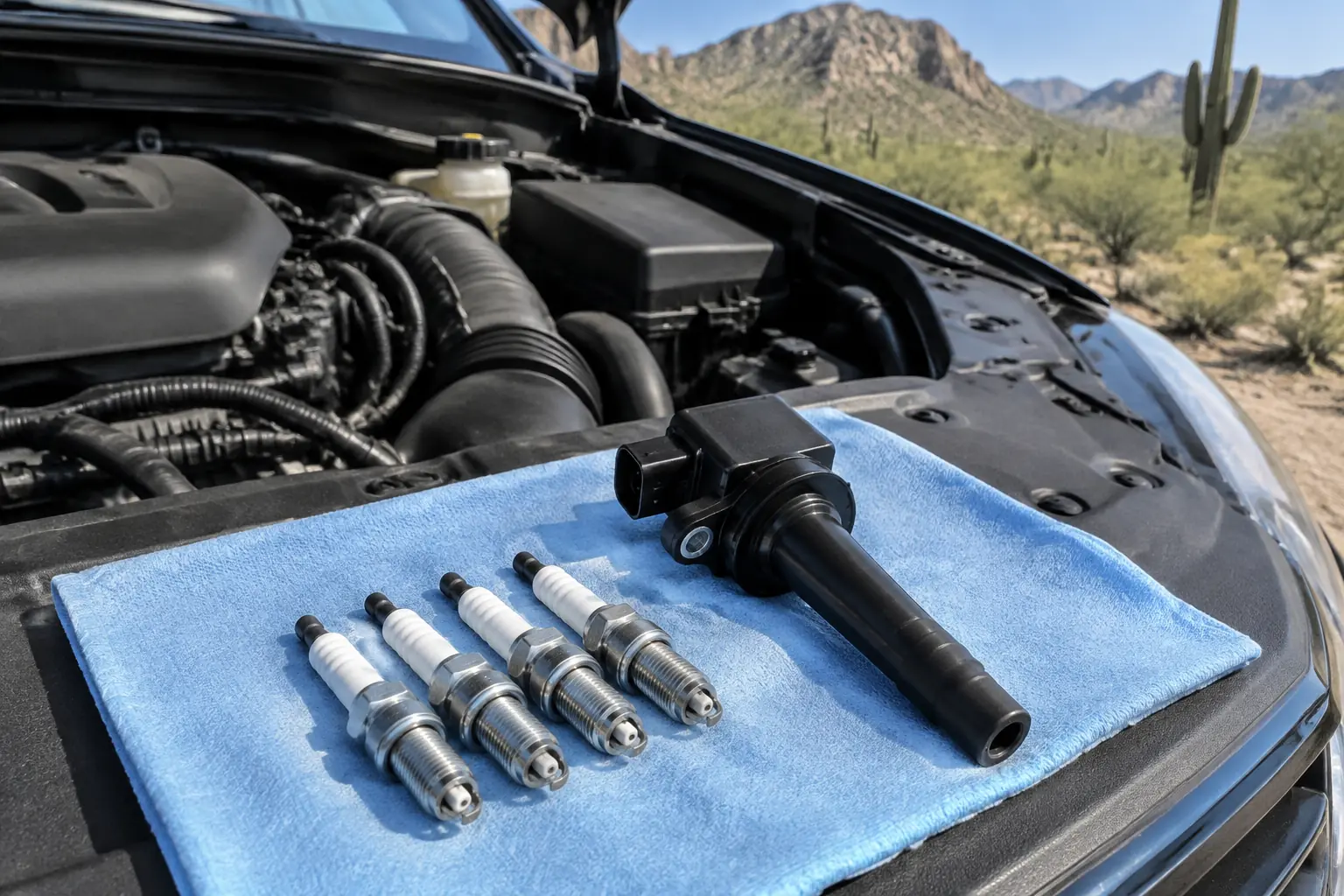
Spark plugs ignite the air-fuel mixture in a gasoline engine. Their firing surfaces wear with use, which is why replacement belongs on the manufacturer's maintenance schedule. The interval depends on the engine and specified plug design. An annual replacement rule or a single mileage figure for every vehicle ignores those differences. Check the schedule for your model and engine before authorizing work.[3]
The replacement specification matters as much as the replacement date. Plug design, heat range, and gap must match the application. Installation also calls for the correct tightening procedure, not simply making each plug feel snug. A plug advertised as an upgrade is not automatically appropriate for your engine. Vehicle-specific service information should guide selection and installation.[1]
If service records are missing, tell us that rather than guessing when the plugs were last changed. We can discuss the schedule, mileage, symptoms, and what inspection can establish. A removed plug can provide clues, but its appearance does not explain every running problem. The aim is to address wear without treating new plugs as a cure for unrelated fuel, air, or mechanical faults.
Ignition coils need evidence before replacement
Ignition coils supply the high voltage needed to fire the spark plugs. Many modern engines place individual coils at the plugs, while other designs use shared arrangements. Unlike spark plugs, coils generally are not a routine replacement item at a universal mileage interval. Their condition and the manufacturer's instructions should determine whether replacement belongs in the job.[1]
A misfire code does not, by itself, prove that a coil has failed. It points toward an operating problem that still needs testing. Plug condition, coil boots, connections, and other possible causes need consideration before parts are condemned. Replacing every coil because one cylinder misfires can leave you paying for parts while the original fault remains.[4]
You can reasonably ask why an estimate recommends one coil, several coils, or none. The answer should connect to test findings, visible damage, or applicable vehicle guidance. If a leaking seal or damaged connection contributed to the failure, that issue also needs attention. Our guide to rough idle and misfire diagnosis explains the broader fault-finding process without assuming ignition parts are always responsible.
Throttle body cleaning should have a reason
The throttle body controls airflow into the engine. Deposits around its opening can contribute to idle problems on some vehicles, but cleaning is not a required addition to every spark plug service. Symptoms, inspection findings, and manufacturer procedures should establish whether it is appropriate. A rough idle can have several causes, so a cleaning recommendation needs more support than the symptom alone.[1]
Electronic throttle bodies also require care. The approved cleaner, handling procedure, and any idle or throttle relearn depend on the vehicle. This is not a component to force open or soak indiscriminately. Ask whether the proposed work includes any necessary adaptation procedure and a check of engine operation afterward. The service should be described as a defined task, not simply an engine cleaning.[4]
Throttle body cleaning is also different from cleaning fuel injectors or addressing intake-valve deposits. Those jobs reach different components and should not be sold as interchangeable solutions. If someone recommends several cleaning services together, ask which finding supports each one. For routine maintenance, the most useful recommendation is specific enough that you understand what will be cleaned and what result is being checked.
Fuel filters depend on your vehicle's design
Some vehicles have a separately serviceable fuel filter with a specified replacement interval. Others use filtration within the fuel tank or pump assembly and do not list a separate routine filter change. That makes "replace the fuel filter" an unreliable default line on a modern tune-up checklist. The correct recommendation comes from the vehicle's fuel-system design and maintenance information.[3]
A suspected fuel-delivery restriction is a diagnostic issue, even if the car is also due for maintenance. Replacing an accessible filter may be appropriate when supported by the schedule or findings, but poor acceleration does not automatically establish a clogged filter. Likewise, an in-tank assembly should not be replaced as a precaution merely because an old-fashioned tune-up package used to include fuel filtration.
Keep fuel additives in perspective, too. A bottle added to the tank does not renew worn spark plugs or repair a failed ignition coil. If a treatment is proposed, ask what it is intended to address and whether it follows vehicle guidance. A clear service plan distinguishes scheduled filter replacement, testing for a fuel-delivery problem, and any separately justified cleaning procedure.
Summer maintenance planning for Oracle Road drivers
As Tucson moves into summer, highs regularly exceed 100 degrees Fahrenheit. That is a useful reminder to review maintenance before you depend on the car for daily trips along Oracle Road or across town on Grant Road. It is not, by itself, evidence that your plugs or coils have failed. Weather provides a planning cue, while records and inspection establish the work.[5]
Before your next service, note whether a hesitation happens only at startup, after the engine warms up, with the air conditioning operating, or during acceleration. These details help distinguish an intermittent concern from a continuously rough-running engine. Describe what you actually feel rather than naming a suspected part. You do not need to recreate a symptom in traffic to give a mechanic useful information.
Dust also deserves attention, but it should not turn this service into an automatic replacement of unrelated components. Engine and cabin air filters have their own inspection needs, covered in our guide to air filters in dusty Tucson. Keep the requests separate so the estimate clearly identifies ignition maintenance, any justified cleaning, and other items you choose to address.
Preventing misfires without replacing everything
The practical prevention plan starts with completing scheduled spark plug service and responding to changes in engine operation. Maintenance can reduce avoidable problems, but it cannot guarantee that a coil, injector, or another component will never fail. Keep records of what was installed and when. Those records help the next diagnosis begin with evidence rather than assumptions about the meaning of "recently tuned up."
Do not wait for a planned maintenance appointment if the check engine light flashes while the engine runs poorly. A flashing light can indicate a misfire capable of damaging the catalytic converter. Get to a safe stopping place, shut the engine off, and arrange assistance rather than continuing your errands. Our flashing check engine light guide covers the immediate response.[6]
A steady warning light or a mild hesitation still deserves prompt attention, even when the car remains driveable. Tell the mechanic about the warning before requesting a routine tune-up. Clearing a code or replacing overdue maintenance parts does not establish that the underlying problem is repaired. A good plan separates what is due from what must be tested, then checks operation after approved work.
How we handle tune-up requests in Flowing Wells
The Mando Guild is a mobile mechanic service, not a walk-in shop. We drive a stocked service van to your home, workplace, or roadside location in greater Tucson, including Flowing Wells. For a tune-up request, the starting conversation covers the vehicle, mileage, service history, and any symptoms. That gives the visit a defined purpose instead of an assumed list of replacement parts.
Every job starts with a diagnosis and a written estimate. Depending on the concern and vehicle, the assessment may involve reviewing maintenance requirements, checking diagnostic information, and examining accessible ignition or air-intake components. We explain which recommendations address scheduled maintenance and which address a fault. Nothing is replaced until you approve it, and we use OEM-grade parts for approved replacements.
We work on most makes and models, but the vehicle and required procedure determine the practical scope of on-site work. Tell us about access restrictions and the parking location when requesting service. You can also discuss related scheduled care through our mobile oil change and maintenance service. Combining requests should make the plan clearer, not turn an oil change into an unexplained tune-up bundle.
What to ask before approving your Tucson tune-up
Before approving the estimate, ask three direct questions: What is due according to the schedule? What did testing or inspection find? What will be checked after the work? These questions help you distinguish preventive service from repair. They also make it easier to compare estimates that use the same tune-up label but include very different tasks, parts, and diagnostic steps.
Have your vehicle's year, make, model, mileage, and available maintenance records ready. Mention warning lights, recent repairs, and any changes in starting or acceleration. If you are unsure of the engine size, say so rather than guessing. Accurate vehicle identification matters when selecting plugs and checking service procedures. You should leave the conversation understanding the proposed work, not merely recognizing the package name.
There is no need to ask for every possible ignition and cleaning service at once. Ask for a vehicle-specific plan that addresses your concern and keeps scheduled care current. The Mando Guild can help you decide what belongs on that plan before replacement begins. Call (520) 704-0441 or request service Monday through Friday, 8 a.m. to 5 p.m.
Sources
- Edmunds, "Car Maintenance." www.edmunds.com/car-maintenance/ (opens in a new tab)
- U.S. Department of Energy, FuelEconomy.gov, "Keeping Your Vehicle in Shape." www.fueleconomy.gov/feg/maintain.jsp (opens in a new tab)
- Car Care Council, "Car Care Guide." www.carcare.org/car-care-guide/ (opens in a new tab)
- Consumer Reports, "Car Maintenance and Repair Guide." www.consumerreports.org/cars/car-maintenance-and-repair-guide/ (opens in a new tab)
- National Weather Service, Tucson, "NWS Tucson Forecast Office." www.weather.gov/twc/ (opens in a new tab)
- Car Care Council, "Don't Let the Check Engine Light Turn You Off From Making Needed Repairs." media.carcare.org/2018-05-01-Dont-Let-the-Check-Engine-Light-Turn-You-Off-From-Making-Needed-Repairs (opens in a new tab)
- U.S. Department of Energy, AFDC, "Maintenance and Safety of Electric Vehicles." afdc.energy.gov/vehicles/electric-maintenance (opens in a new tab)
FAQ
Quick answers
Keep reading
 Pillar guideThe Tucson Driver's Guide to Mobile Oil Changes and MaintenancePlan mobile oil changes and seasonal maintenance around Tucson's heat, dust, and monsoon weather without a trip to a shop.Read more: The Tucson Driver's Guide to Mobile Oil Changes and Maintenance →
 9 min readDoes Tucson Heat Put Your Car on the Severe Service Schedule?Learn how Tucson heat, dust, and short trips affect your car's maintenance schedule and where to find the right intervals.Read more: Does Tucson Heat Put Your Car on the Severe Service Schedule? →
 9 min readChoosing the Right Engine Oil for Tucson Summer HeatLearn how oil chemistry, viscosity, and your engine's specifications guide the right oil choice for Tucson summer driving.Read more: Choosing the Right Engine Oil for Tucson Summer Heat →